Short answer: yes, gold-filled jewelry can be soldered, but it’s less forgiving than solid gold. Gold-filled is a layer of gold bonded over a brass core, and too much heat makes that gold layer blend into the brass, leaving a dark, discolored joint. Use a low-temperature gold solder, keep the heat brief and controlled, or take the piece to a jeweler.
At a glance
| Question | Answer |
|---|---|
| Can it be soldered? | Yes, with care |
| Solder to use | Easy-grade yellow gold solder, often 9K–14K, for color match |
| Biggest risk | Overheating, which ruins the gold layer |
| Annealing (softening with heat)? | Avoid it |
| Finish afterward | Light polish; some jewelers gold-plate the whole piece |
| Beginner-friendly? | Not really; practice on scrap first |
What is gold-filled, exactly?
Gold-filled is not plated and not solid gold. It’s a thick layer of gold alloy that is mechanically bonded (pressed and heated) onto a base metal, usually brass.
Under the FTC Jewelry Guides, a product can be called “gold filled” when:
- The gold layer is at least 10 karat, and
- The gold makes up at least 1/20 of the total metal weight.
That’s why you’ll see stamps like 1/20 14K GF. It means 1/20 of the weight is 14K gold.
Compare it with other gold finishes:
| Type | Gold layer | Can it be soldered? |
|---|---|---|
| Solid gold | Gold all the way through | Yes, the easiest |
| Gold-filled | Thick bonded layer over brass | Yes, carefully |
| Gold vermeil | Plating over sterling silver | Yes, but the plating usually needs redoing |
| Gold-plated | Very thin layer over base metal | Plating burns off; needs replating |
Not sure what your piece is? Our guide to whether gold-plated chains are fake explains the common stamps.
Why soldering gold-filled is tricky
The layers can mix
The gold layer and the brass core melt at different temperatures, and both are fairly close to the solder’s flow point. Cooksongold’s guide puts solder flow at roughly 690–788°C, the gold layer at about 843°C and the brass core at about 900°C. That’s a narrow window.
Heat too long or too hot and the gold alloys with the brass underneath. The result is a dark, coppery patch that won’t polish out.
Exposed brass tarnishes
If you file or sand through the gold layer to clean up a joint, you expose the brass. Brass tarnishes quickly and can turn skin green.
There’s no gold-filled solder
Solder is its own alloy, so you can’t buy “gold-filled solder.” You pick a gold solder that matches the color as closely as possible.
How jewelers solder gold-filled
This is an overview, not a step-by-step lesson. If you’re new to torch work, practice on scrap wire first.
- Use a low-temperature gold solder. An “easy” or “extra easy” grade of yellow gold solder, often 9K to 14K, flows at a lower temperature and matches the color.
- Make a tight-fitting joint. Solder bridges small gaps, not big ones. A clean, snug fit needs less solder and less heat.
- Flux the joint to keep it clean and help the solder flow.
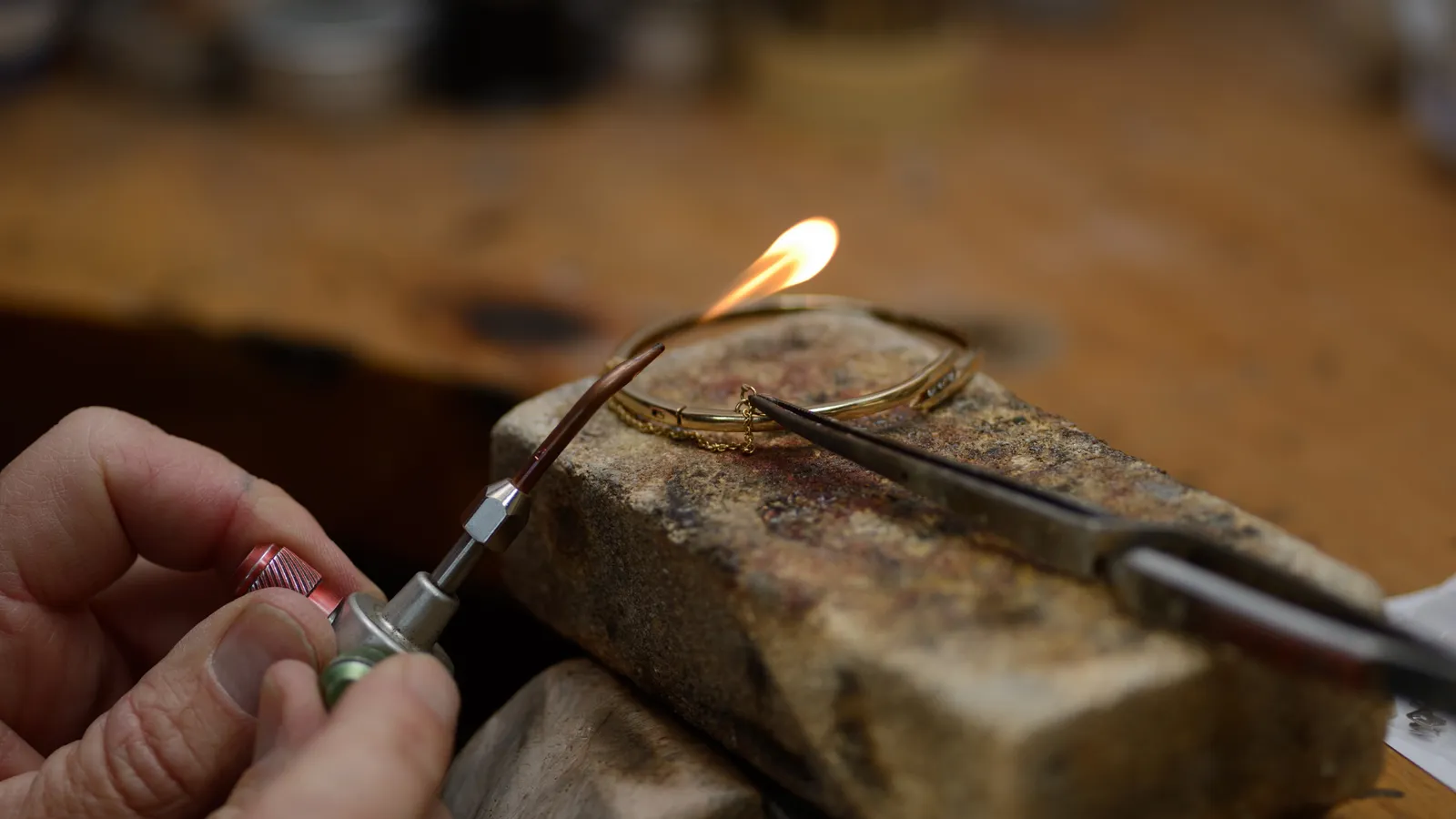
- Use a small, soft flame. Keep the flame moving and heat the whole joint evenly.
- Stop as soon as the solder flows. Pull the flame right away. Extra seconds are what cause damage.
- Use tiny bits of solder. Excess solder has to be filed off, which can cut through the gold layer.
- Keep joints to a minimum. Each new joint reheats the piece and raises the risk.
- Don’t anneal. Repeated heating to soften the metal damages the gold layer.
Want the basics of how jewelers join metal? See how rings are soldered together.
Torch safety
Jewelry torches and soldering chemicals can cause burns, fires and fumes. Work on a fireproof surface with good ventilation, wear eye protection, and follow the instructions for your torch, flux and pickle.
Alternatives to soldering
- Jump rings and crimps: for many chain and bead repairs, a closed jump ring or crimp bead does the job with no heat at all.
- Laser welding: some jewelers have a laser welder, which heats a much smaller spot than a torch. Ask whether it suits your piece.
- Replace the part: a new gold-filled clasp or jump ring is often cheaper than repairing the old one.
- Replating: if a joint has discolored, a jeweler can gold-plate the whole piece so the color is even.
When to take it to a jeweler
- The piece has stones, pearls or enamel near the break
- It’s a fine or delicate chain
- It has sentimental value
- You’ve never used a jewelry torch
Ask the jeweler upfront whether they work on gold-filled. Some prefer not to because of the heat risk, while others are happy to repair or laser-weld it.
Caring for gold-filled jewelry after a repair
- Clean it with mild soap and warm water, then dry it well.
- Avoid harsh polishing compounds, which wear the gold layer.
- Store it separately so harder pieces don’t scratch it.
- Take it off for swimming in chlorinated pools and for cleaning with household chemicals.
Frequently asked questions
Is there a special gold-filled solder?
No. Solder is an alloy, so there’s no true gold-filled solder. Jewelers usually use a low-karat yellow gold solder (often 9K, 10K or 14K, in an easy grade) to match the color.
Can I solder gold-filled with a soldering iron?
Not with electronics solder. Lead or tin solder is soft, the wrong color and makes a weak, ugly joint. Jewelry soldering uses a small torch and gold solder.
Can a jeweler repair a broken gold-filled chain?
Usually, yes. Many jewelers can solder or laser-weld a gold-filled chain or replace the clasp. Ask whether they work on gold-filled, since not all do.
Will soldering change the color of gold-filled jewelry?
It can. Overheating lets the gold layer mix with the brass core and leaves a dark spot. Jewelers sometimes gold-plate the piece afterward to even out the color.