Short answer: most gold chains are made by melting gold with other metals into an alloy, rolling and drawing that alloy into thin wire, and feeding the wire into machines that cut, shape and link it into chain. The links are then soldered shut, and the chain is cleaned, polished, fitted with a clasp and stamped with its karat. Hollow chains add one extra trick: a core that gets dissolved away.
At a glance: the main steps
- Alloying: melt pure gold with metals like silver, copper and zinc to set the karat.
- Casting: pour the alloy into bars or rods.
- Rolling and wire drawing: squeeze the metal thinner and pull it through smaller and smaller dies.
- Annealing: heat the wire to soften it between steps.
- Link forming: machines (or hands) cut, bend and interlock the links.
- Soldering: each link is joined so it can’t open.
- Shaping and finishing: flatten, twist, diamond-cut and polish.
- Clasp and stamp: add the clasp, end caps and karat mark.
Step 1: Mixing the alloy
Pure 24K gold is too soft for most chains, so it’s melted with other metals. The mix sets both the karat and the color:
| Karat | Gold content | Common additions |
|---|---|---|
| 10K | About 42% | More silver, copper, zinc |
| 14K | About 58% | Silver, copper, zinc |
| 18K | 75% | Smaller amounts of silver and copper |
More copper gives a warmer or rosier color; other metals are used for white gold. See what is rose gold? and what is white gold?
Step 2: Casting, rolling and drawing wire
The molten alloy is cast into a bar or rod. That bar is then:
- Rolled through steel rollers to make it longer and thinner.
- Drawn through a series of dies, each with a slightly smaller hole, until it reaches the exact wire thickness the chain needs.
Drawing hardens the metal, so the wire is annealed (heated and cooled) between passes to keep it workable and stop it cracking.
Step 3: Forming the links
Machine-made chains
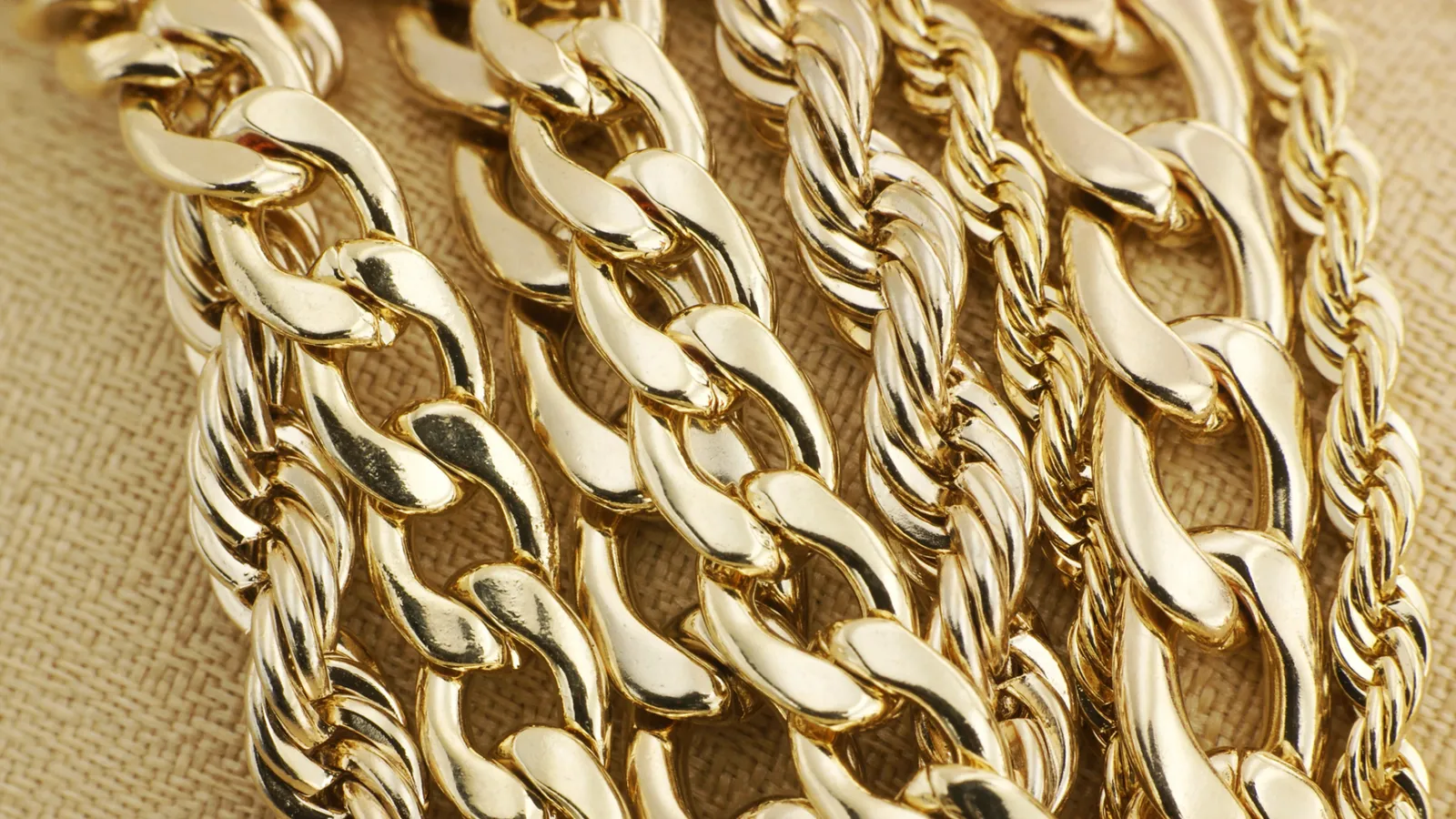
Most chains today are made on chain-making machines. A spool of wire feeds in, and the machine cuts each piece, bends it into a link and threads it through the previous one. Different machines make different patterns: cable, curb, rope, box, Figaro and more. Machines can run for hours producing continuous lengths of chain that are later cut to size.
Handmade chains
A goldsmith can also make chain by hand: wrapping wire around a mandrel to make coils, cutting the coils into rings, then opening, linking and closing each one. It’s slow work, so handmade chains are usually custom, heavy or high-end pieces.
Step 4: Soldering the links
An open link can be pulled apart, so in quality chains each link’s seam is soldered. On a production line this is often done by coating the chain with solder powder and passing it through a furnace so every joint closes at once.
The Ganoksin jewelry-making resource warns that links with incompletely soldered seams can crack open when the chain is twisted or drawn, which is why good soldering matters so much for strength. Many broken chains fail at a weak joint. See can a real gold chain break?
Step 5: Shaping and finishing
After soldering, the chain is shaped into its final style:
- Hammering or pressing flattens curb (Cuban) links so they lie flat.
- Twisting creates the tight spiral of a rope chain.
- Diamond cutting uses cutting tools to carve small flat facets into the surface, which makes the chain sparkle.
- Polishing in tumblers or by hand gives the final shine.
How hollow chains are made
Hollow chains look big but use much less gold. According to Ganoksin, chain goes through a lot of bending during manufacture, so hollow chain (apart from the largest handmade ones) needs a core for support. The gold is formed around a core metal such as copper, the chain is made as normal, and then the core is dissolved chemically, leaving a thin gold shell.
| Construction | Gold use | Durability |
|---|---|---|
| Solid | Highest | Strongest, easiest to repair |
| Semi-solid | Medium | Fairly sturdy |
| Hollow | Lowest | Dents and kinks more easily |
Under the FTC’s Jewelry Guides, a gold chain with a hollow center should be disclosed as hollow and shouldn’t be called “solid.” Learn more in what is a semi-hollow gold chain?
Step 6: Clasp, end caps and stamping
Finally, the chain is cut to length, end caps and a clasp (usually a lobster claw or spring ring) are soldered on, and the karat is stamped on the clasp or a small tag. Common marks include 10K/417, 14K/585 and 18K/750.
Plated chains are made differently
Gold-plated chains are usually made from brass, steel or silver, then coated with a thin layer of gold at the end. They can look identical to solid gold on day one. See are gold-plated chains fake?
Frequently asked questions
Are gold chains made by machine or by hand?
Most chains sold today are made on chain-making machines that form and join links from a continuous wire. Handmade chains exist, especially heavy or custom pieces, and cost more because of the labor.
Why are hollow chains cheaper?
They use much less gold. The links are formed around a core that is later dissolved, leaving a gold shell. That makes them lighter and cheaper, but also easier to dent.
Are the links of a gold chain soldered?
In most good-quality chains, yes. Each link is closed and soldered so it can’t pull open. Poorly soldered links are a common weak point.
Where is the karat stamp added?
Usually on the clasp or a small tag attached near it, after the chain is finished.