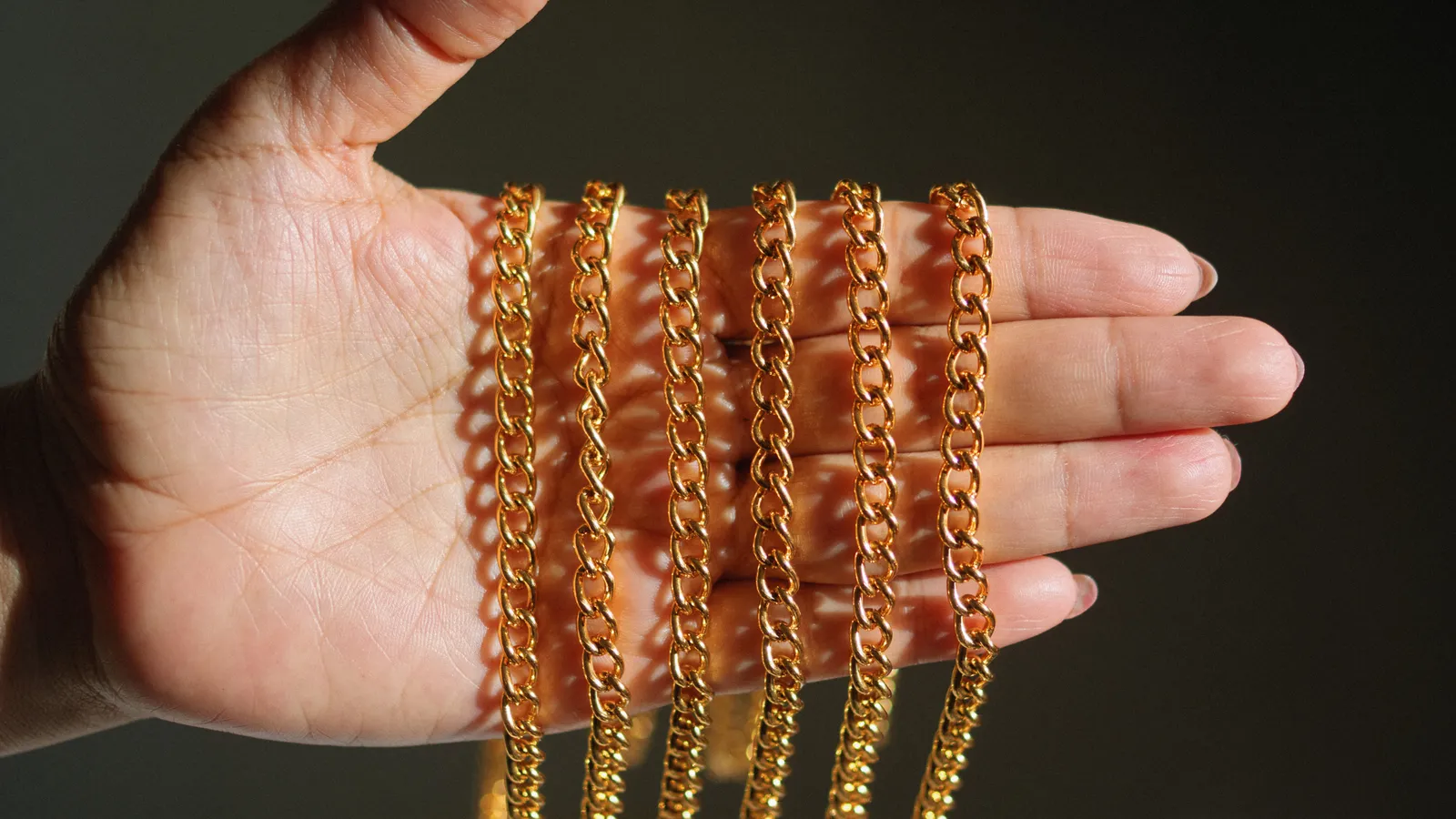
Short answer: a gold chain can weigh a few grams or well over 100 grams. Thin, delicate chains are typically in the low single digits, everyday men’s chains often weigh tens of grams, and wide solid Cuban or rope chains can go far higher. For a real reference point, one retailer lists a 20-inch, 5 mm solid 14K Cuban chain at 40 grams and a similar-looking hollow version at about 19 grams.
Quick reference
| Chain type | Typical weight |
|---|---|
| Fine chains for pendants (about 1–2 mm) | A few grams |
| Medium everyday chains (about 3–4 mm) | Roughly 10–30 grams if solid; less if hollow |
| 5 mm solid 14K Cuban, 20 in (one retailer’s listing) | 40 grams |
| 5.5 mm hollow 14K Cuban, 20 in (same retailer) | 19.1 grams |
| Wide solid Cuban or rope (8 mm+) | Can reach 100+ grams |
These are rough guides. Always compare listings for the exact style, width and length.
Why chain weights vary so much
Four things set the weight:
- Width. A wider chain has bigger, thicker links. It’s the biggest single factor.
- Length. Weight goes up roughly in proportion. A 24-inch chain weighs about 20% more than the same chain at 20 inches.
- Construction. Solid links are gold all the way through. Semi-solid and hollow links have empty space inside and can weigh half as much or less.
- Karat. Higher-karat gold is denser, so an 18K chain weighs more than an identical 14K chain.
For more on how these factors play out, see how much a solid gold chain should weigh.
What gold purity means for the grams
A chain’s weight isn’t all gold. The karat tells you the share:
| Karat | Pure gold | Stamp |
|---|---|---|
| 10K | 41.7% | 10K or 417 |
| 14K | 58.3% | 14K or 585 |
| 18K | 75% | 18K or 750 |
| 22K | 91.7% | 22K or 916 |
| 24K | 99.9% | 24K or 999 |
In the US, items under 10K shouldn’t be sold as gold under the FTC’s Jewelry Guides, so 10K is the lowest karat you’ll normally see on a chain stamped as gold.
How to work out the gold in your chain
- Weigh it. Use a digital scale that reads to 0.1 gram or finer. Kitchen scales that read whole grams aren’t accurate enough for thin chains.
- Multiply by the purity. For a 25-gram 14K chain: 25 × 0.583 = about 14.6 grams of pure gold.
- Estimate melt value (optional). Gold’s spot price is quoted per troy ounce, which is about 31.1 grams. Divide the spot price by 31.1 to get a price per gram, then multiply by your pure gold grams.
Remember, melt value isn’t what you’ll be paid. Buyers keep a margin, and a retail price includes labor and markup. If you’re thinking long-term, see do gold chains hold value.
Grams vs pennyweight
Some jewelers and gold buyers use pennyweight (dwt) instead of grams. One pennyweight is about 1.555 grams, so a 31-gram chain is about 20 dwt. Ask which unit a quote uses before comparing.
How to check your chain’s karat and content
Look for a stamp
Check near the clasp or end caps for 10K, 14K, 18K, 417, 585 or 750. Stamps like GP, GEP, HGE or GF mean plated or gold-filled, so most of the weight isn’t gold. A magnifying glass or jeweler’s loupe helps on small chains.
Ask for an acid or electronic test
A jeweler can rub the chain on a test stone and apply acids that react differently to each karat. Many also have electronic testers or XRF machines that read metal content without leaving a mark. These are the reliable options.
The magnet test (a first check only)
Gold isn’t magnetic, so a chain that jumps to a strong magnet probably has a steel or iron core. But plenty of fake metals aren’t magnetic either, so passing proves nothing. See why a gold chain can be slightly magnetic.
Skip the “float” and “bite” tests
Real gold and many fakes both sink in water, and biting a chain only damages it. Neither tells you anything useful.
Choosing the right weight for you
- For pendants: a fine chain of a few grams is fine for a light pendant. Heavier pendants need a sturdier chain.
- For everyday wear: a mid-weight solid chain resists kinks and breaks better than a very fine or hollow one.
- For a statement piece: wide chains look bold but get heavy fast. Try one on before you buy if you can.
Not sure about length? Our guide on how to measure a necklace helps you pick the right size before you compare weights.
Frequently asked questions
How many grams is a 14K gold chain?
Anywhere from a few grams for a thin chain to over 100 grams for a wide Cuban link. Width, length, link style and whether it’s solid or hollow matter more than the karat.
How do I convert grams to pennyweight?
One pennyweight (dwt) is about 1.555 grams. Divide grams by 1.555 to get pennyweight. Some jewelers and gold buyers quote prices per dwt.
How many grams of pure gold are in a 10-gram 14K chain?
About 5.8 grams. 14K is about 58.3% gold, so multiply 10 by 0.583.
Will a gold buyer pay full value for the gold in my chain?
Usually not. Buyers pay a percentage of the melt value to cover refining and profit. Get quotes from a few places before selling.