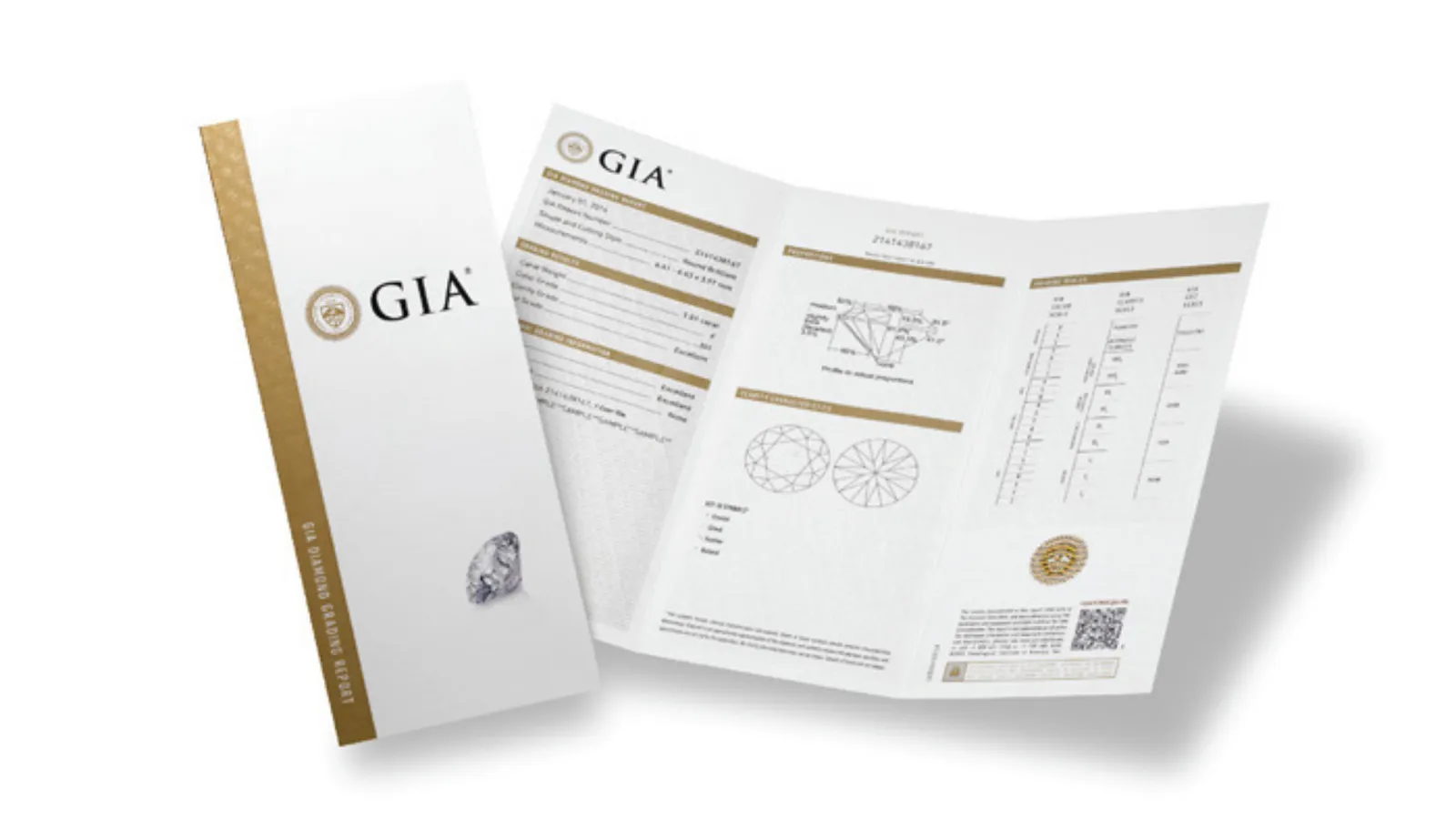
Short answer: a GIA diamond certificate (officially a grading report) is a lab’s independent description of one diamond. Read it in this order: check the report number, then the grading results (carat, color, clarity, cut), then the additional grading information (polish, symmetry, fluorescence, comments), then the diagrams. Finally, confirm the report on GIA’s website.
At a glance
| Section | What it tells you |
|---|---|
| Report number and date | Unique ID you can verify online |
| Shape and cutting style | E.g. round brilliant, oval brilliant |
| Measurements | Length, width and depth in millimeters |
| Carat weight | Weight to two decimal places |
| Color grade | D (colorless) to Z (light yellow or brown) |
| Clarity grade | FL down to I3 |
| Cut grade | Excellent to Poor (round brilliants only) |
| Polish, symmetry | Finish quality, Excellent to Poor |
| Fluorescence | Glow under UV light: None to Very Strong |
| Inscription(s) | Any laser inscription on the girdle |
| Comments | Extra notes, e.g. features not shown on the plot |
What is a GIA certificate, exactly?
The Gemological Institute of America (GIA) is a nonprofit lab that grades diamonds but doesn’t sell them. Its report records the diamond’s 4Cs and other characteristics, and GIA tests every stone to confirm it is a diamond and to look for known treatments.
Two things a GIA report is not:
- Not an appraisal. It doesn’t state a value or price.
- Not a guarantee of the setting or the store. It describes the loose stone that GIA examined.
New to the 4Cs? Start with our guide to the 4Cs of diamonds.
Step 1: The report number
Find the report number near the top. Then:
- Go to GIA Report Check on gia.edu and enter the number.
- Make sure the carat weight, measurements and grades match your paper or PDF.
- If the report lists an inscription, ask the jeweler to show you that number on the diamond’s girdle (the thin outer edge) under magnification.
If the details don’t match, don’t buy until it’s explained.
Step 2: Grading results (the 4Cs)
Carat weight
Shown to two decimal places, such as 1.01 carats. A difference of a few points (hundredths) can affect price, especially near popular sizes like 1.00 carat.
Color grade
GIA grades colorless-range diamonds from D to Z. D is completely colorless; further down the alphabet, a faint yellow or brown tint becomes easier to see. Colored diamonds get a separate “fancy color” description.
Clarity grade
Clarity measures inclusions (internal features) and blemishes (surface features) seen at 10× magnification. The scale has 11 grades:
- FL (Flawless) and IF (Internally Flawless)
- VVS1, VVS2 (very, very slightly included)
- VS1, VS2 (very slightly included)
- SI1, SI2 (slightly included)
- I1, I2, I3 (included)
More detail in what is diamond clarity and what a VVS diamond is.
Cut grade
For standard round brilliants, GIA gives an overall cut grade from Excellent to Poor. It reflects how well the proportions and finish return light. Fancy shapes (oval, pear, princess and so on) don’t get this overall grade.
Step 3: Additional grading information
- Polish: how smooth the facet surfaces are.
- Symmetry: how precisely the facets line up.
- Fluorescence: how strongly the diamond glows under ultraviolet light, from None to Very Strong. Most fluorescence has no visible effect in normal light; see what is diamond fluorescence.
- Inscription(s): any laser inscription GIA found, usually the report number.
- Comments: anything that doesn’t fit elsewhere, such as clarity features that aren’t plotted (for example graining or extra facets) or a treatment note.
Read the comments box
Comments can mention things that affect value or appearance, such as clouds not shown on the plot or surface graining. If a comment is unclear, ask the seller to explain it, or ask an independent jeweler.
Step 4: The diagrams
Proportions diagram
A side-view drawing with percentages and angles: table size, crown angle, pavilion angle, total depth, girdle thickness and culet. You don’t need to memorize ideal numbers. The cut grade (for rounds) already summarizes them.
Clarity characteristics plot
A map of the diamond’s main inclusions and blemishes, viewed from the top and bottom. A key next to it explains the symbols. As a rule:
- Red symbols mark internal characteristics (inclusions), such as crystals or feathers.
- Green symbols mark external characteristics (blemishes).
The plot shows type and location, not exact size. Use it to check that the stone you’re holding is the stone on the report.
Step 5: Security features and report types
Paper GIA reports include security features such as a hologram and microprint, and GIA also issues digital reports. Smaller stones may come with a Diamond Dossier, a shorter report that covers the 4Cs but has no clarity plot. If you’re comparing labs, our guide to GIA vs. GSI reports explains the differences.
A quick checklist before you buy
- Report number checks out on GIA’s site.
- Weight and measurements match the stone.
- Inscription (if any) matches the report.
- Comments read and understood.
- Report says natural or laboratory-grown, as you expect.
Frequently asked questions
Is a GIA certificate the same as an appraisal?
No. A GIA report describes the diamond’s quality; it doesn’t put a price on it. For insurance you need a separate appraisal from a qualified appraiser.
Why doesn’t my fancy-shaped diamond have a cut grade?
GIA gives an overall cut grade only to standard round brilliant diamonds in the D-to-Z color range. Other shapes still get polish and symmetry grades plus measurements.
What’s the difference between a GIA report and a GIA Diamond Dossier?
The Dossier is a more compact report for smaller diamonds. It covers the 4Cs and usually includes a laser inscription of the report number, but it doesn’t include a clarity plot.
Can a GIA report be faked?
Paper reports can be copied, which is why you should always look up the report number on GIA’s free Report Check and compare it with the stone and any laser inscription.