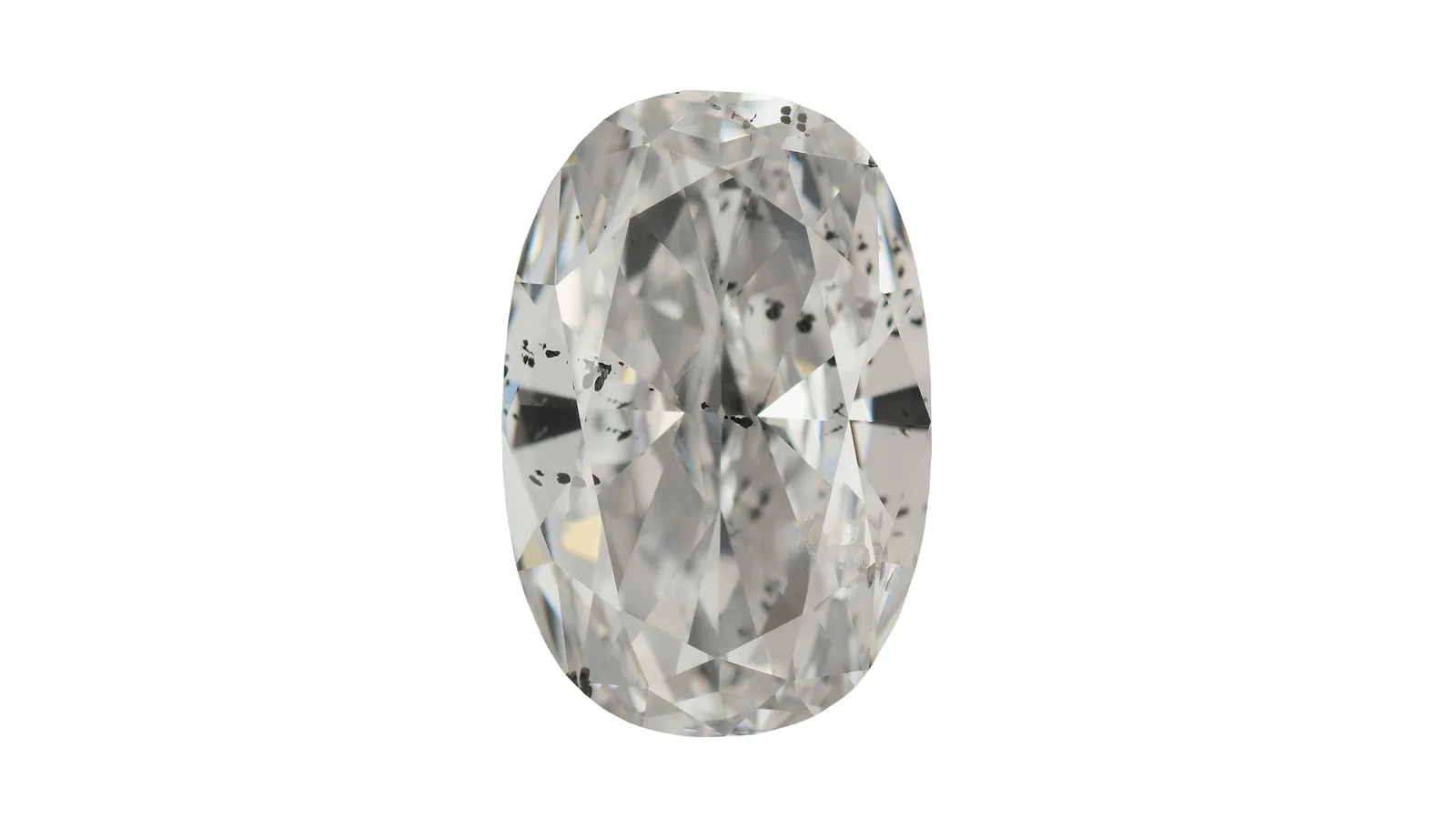
Short answer: black spots in a diamond are inclusions, usually tiny crystals of other minerals that got trapped as the diamond grew. Some are graphite, others are sulfides or iron-rich minerals. They don’t harm the diamond, but because dark spots contrast with the bright stone, they’re easier to see than white inclusions, so they can lower the clarity grade and the price.
At a glance
| Question | Answer |
|---|---|
| What are they? | Mostly dark mineral crystals and pinpoints |
| Are they “carbon”? | Sometimes graphite, often other minerals |
| Do they weaken the diamond? | Small ones usually don’t |
| Do they affect price? | Yes, if visible or in the center |
| Lab report name | Crystal, pinpoint, cloud, etc. |
What causes black spots in diamonds?
Diamonds form under enormous heat and pressure deep in the earth. As they grow, they can trap bits of other minerals. GIA calls these crystals: mineral crystals contained in a diamond. Very small ones that look like dots at 10x magnification are called pinpoints.
Most included crystals are colorless or white. Some are dark. GIA’s research on dark diamonds lists sulfides, graphite, magnetite, hematite and other iron-bearing minerals as dark inclusions. Which one you’re looking at can only be confirmed with lab instruments, not by eye.
Is it really “carbon”?
Jewelers often call any dark spot a “carbon spot.” It’s a convenient nickname but not accurate. Diamond itself is carbon, and some dark inclusions are graphite (another form of carbon), but many are different minerals entirely. Grading reports don’t use the term.
Do black spots affect a diamond’s value?
Yes, depending on four things:
- Size. A dot only visible under 10x magnification matters little.
- Location. A spot under the table (the big top facet) is easiest to see. Near the edge, it may hide under a prong.
- Number. A scattering of dark spots, like the stone in our photo, is far more noticeable than a single one.
- Contrast. Dark inclusions show up more than white ones of the same size.
Graders weigh all of these when assigning a clarity grade. See what is diamond clarity for how the scale works.
Can black spots make a diamond crack?
Usually not. Small crystals are stable. Risk goes up when a large inclusion sits near the surface or a girdle edge, or when it’s connected to a feather (a small break). Those are the cases worth asking a jeweler about. Our guide to feather inclusions explains more.
Can black spots be removed?
Not by cleaning: they’re inside the stone. The options are:
- Laser drilling: a laser drills a tiny tunnel to the dark inclusion, then it’s bleached or dissolved with acid. GIA also lists a method that expands an existing feather around the dark inclusion so it reaches the surface. Both must be disclosed and lower value.
- Recutting: sometimes a near-surface spot can be polished away, at the cost of weight.
- Smart setting: placing a prong over an edge inclusion.
Read more about clarity-enhanced diamonds before you buy one that has been treated.
How to avoid noticeable black spots
- Look at the plot on the grading report, the diagram showing where inclusions sit.
- Ask for magnified photos or video of the actual stone.
- Aim for a stone that’s eye-clean, meaning you can’t see inclusions without magnification at a normal viewing distance. In SI grades, check carefully, because some are eye-clean and some aren’t.
- Avoid dark inclusions in the center of the table.
Not sure which inclusions matter most? Here’s our list of diamond inclusions to avoid.
Frequently asked questions
Are black spots in diamonds “carbon spots”?
That’s a common trade nickname, but it’s misleading. Dark spots are usually other mineral crystals, though some are graphite, a form of carbon. A lab report simply lists them as crystals or pinpoints.
Can black spots be removed?
Sometimes they’re lasered: a tiny channel is drilled to the spot and it is bleached or dissolved. Laser drilling must be disclosed and leaves a visible tunnel under magnification.
Do black spots make a diamond fake?
No. Natural inclusions are actually evidence the stone grew in the earth. Lab-grown diamonds have inclusions too, often metallic ones.
Is a black spot under a prong a good idea?
If a small dark crystal sits near the edge, a jeweler can sometimes position a prong over it so it disappears in the setting.