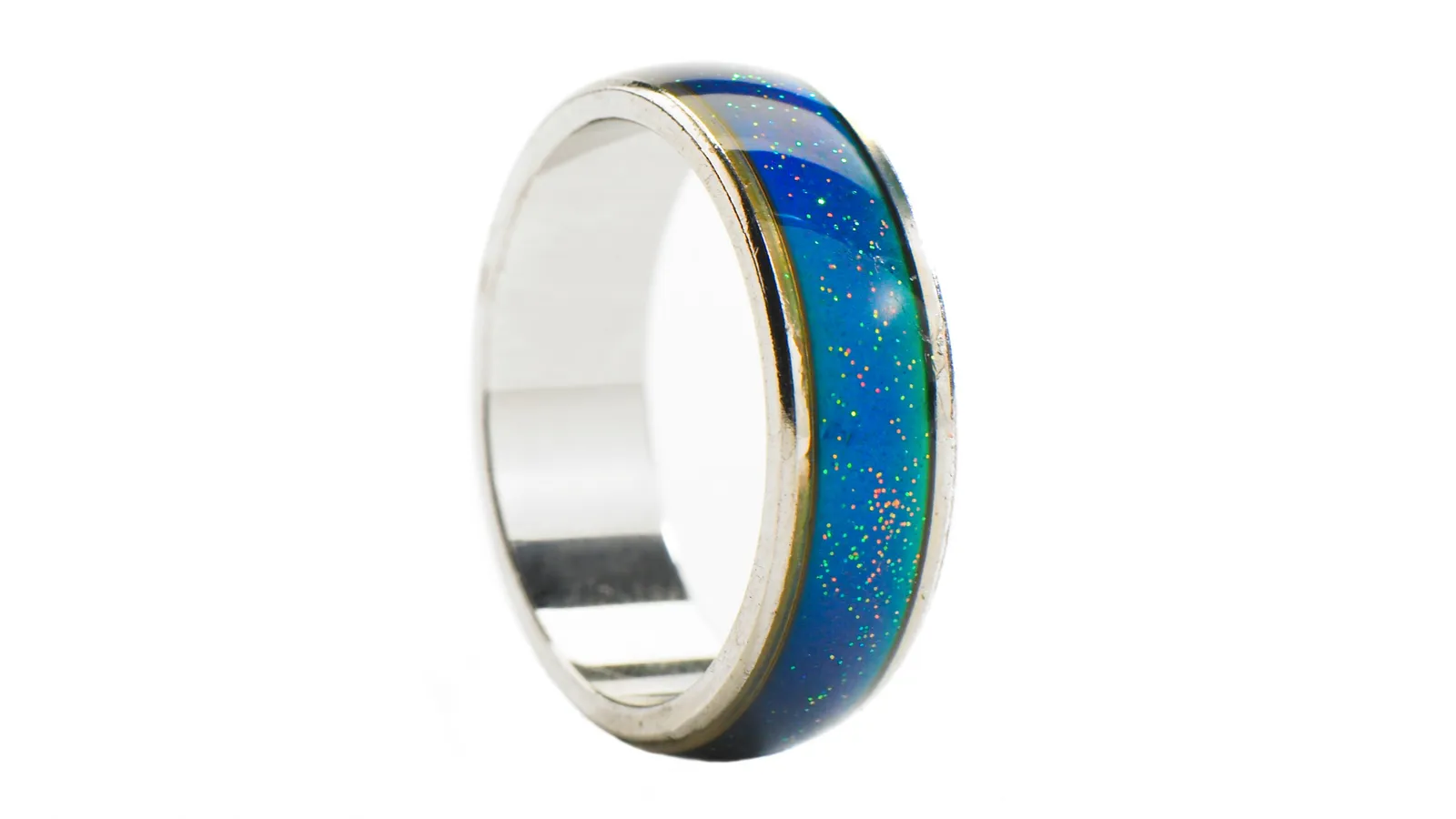
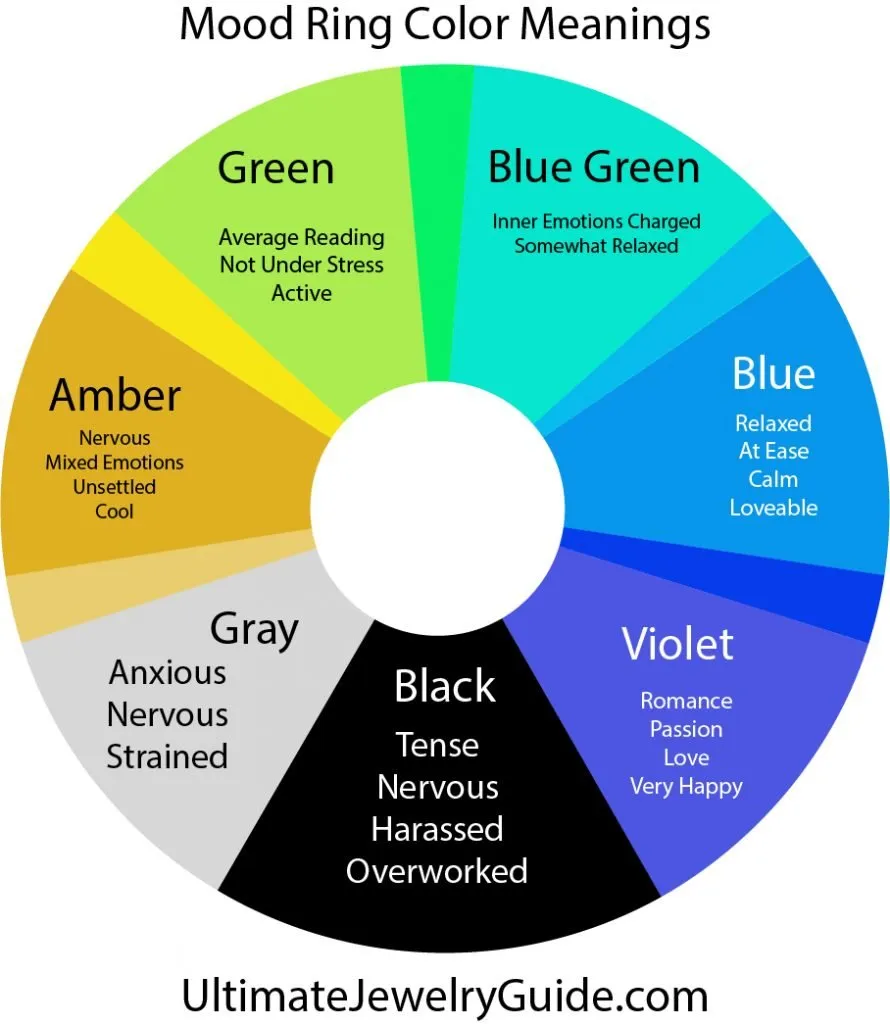
Short answer: mood rings change color with the temperature of your finger, not your feelings. On most charts, black means tense or stressed, amber means nervous, green means average, blue means calm and violet means happy or passionate. Emotions can nudge skin temperature, so the colors sometimes line up with your mood, but treat the ring as fun, not a lie detector.
Mood ring colors at a glance
| Color | Usual meaning | What’s really happening |
|---|---|---|
| Black | Tense, stressed, overworked | Coldest reading, or a damaged stone |
| Gray | Anxious, strained | Cool |
| Amber / brown | Nervous, unsettled | Slightly cool |
| Green | Average, alert | Around normal finger temperature |
| Blue-green | Somewhat relaxed | A little warmer |
| Blue | Calm, relaxed | Warm |
| Dark blue / violet | Happy, romantic, passionate | Warmest reading |
How do mood rings work?
The “stone” in a mood ring is usually a clear glass or plastic dome sitting over a layer of thermochromic liquid crystals. A liquid crystal is a material with properties of both a liquid and a solid. These crystals subtly change their structure as temperature changes, which changes which color of light they reflect.
- Cooler finger → darker colors (black, gray, amber).
- Warmer finger → blue and violet.
Your finger’s temperature depends largely on blood flow to your hands, which shifts with the room temperature, exercise, illness and, to some degree, how you feel.
What each mood ring color means
These meanings come from the classic charts sold with mood rings. They aren’t scientific, and charts vary between brands.
Black
The traditional “stressed” color. In practice it usually means your hand is cold. A ring that stays black even on a warm hand may have water damage.
Gray
Anxious or strained. A cool reading.
Amber or brown
Nervous, mixed emotions or unsettled. Your finger is a little below its usual temperature.
Green
The “average” or neutral reading. Many people see green most of the time.
Blue-green
Somewhat relaxed. Your hand is getting warmer.
Blue
Calm, relaxed, at ease. A warm, comfortable hand.
Dark blue and violet
Happy, romantic or passionate. These are the warmest readings, which is why you might see them after exercise or sitting near a heater.
Are mood rings accurate?
Not as mood detectors. They’re accurate thermometers over a narrow range, and that’s all.
Why the colors can mislead you:
- The room matters more than your mood. Cold weather or air conditioning pushes most rings toward black and amber.
- People run warm or cool. Some people have naturally warm or cool hands.
- Stress can go either way. Stress often narrows blood vessels in the hands, cooling them, but a hot flush of anger or excitement can warm your skin.
- Rings differ. Each maker uses a slightly different crystal mix calibrated to a different temperature range.
Where did mood rings come from?
According to History.com, Josh Reynolds and Maris Ambats introduced the mood ring in US stores in 1975, and $20 million worth sold by the end of that year. The Lawrence Livermore National Laboratory notes that former lab engineer Robert Parker, who had been experimenting with liquid crystals, produced the color-changing material for mood rings at his own company in California.
The craze faded quickly, but mood rings never disappeared. They’re still popular as gifts for kids and as retro fashion. For more 20th-century jewelry trivia, see our jewelry history facts.
How to make a mood ring last
- Keep it dry. Take it off before washing your hands, showering or swimming.
- Keep it out of direct sun and away from heat sources when you’re not wearing it.
- Store it on its own so the stone doesn’t get scratched.
- Expect the metal to tarnish if it’s inexpensive. A quick wipe with a soft cloth helps.
If the band leaves a green mark on your finger, that’s the base metal reacting with your skin, not the stone. Our guide to the best jewelry for sensitive skin explains which metals avoid it.
Frequently asked questions
Why is my mood ring always black?
Either your finger is cool, or the ring is old or damaged. Moisture getting into the stone can permanently ruin the liquid crystals, leaving it stuck on black or dark gray.
What is the rarest mood ring color?
There's no official answer, but the colors at the warm end (deep blue and violet) need a warmer finger than usual, so many people see them less often.
Can a mood ring get wet?
Take it off for washing up, showering and swimming. Water can seep under the stone and damage the crystals, and most mood rings use inexpensive metal that tarnishes.
Do mood rings work on everyone the same way?
No. Rings use different crystal mixes, and people's finger temperatures differ, so the same mood can show different colors on different people or rings.