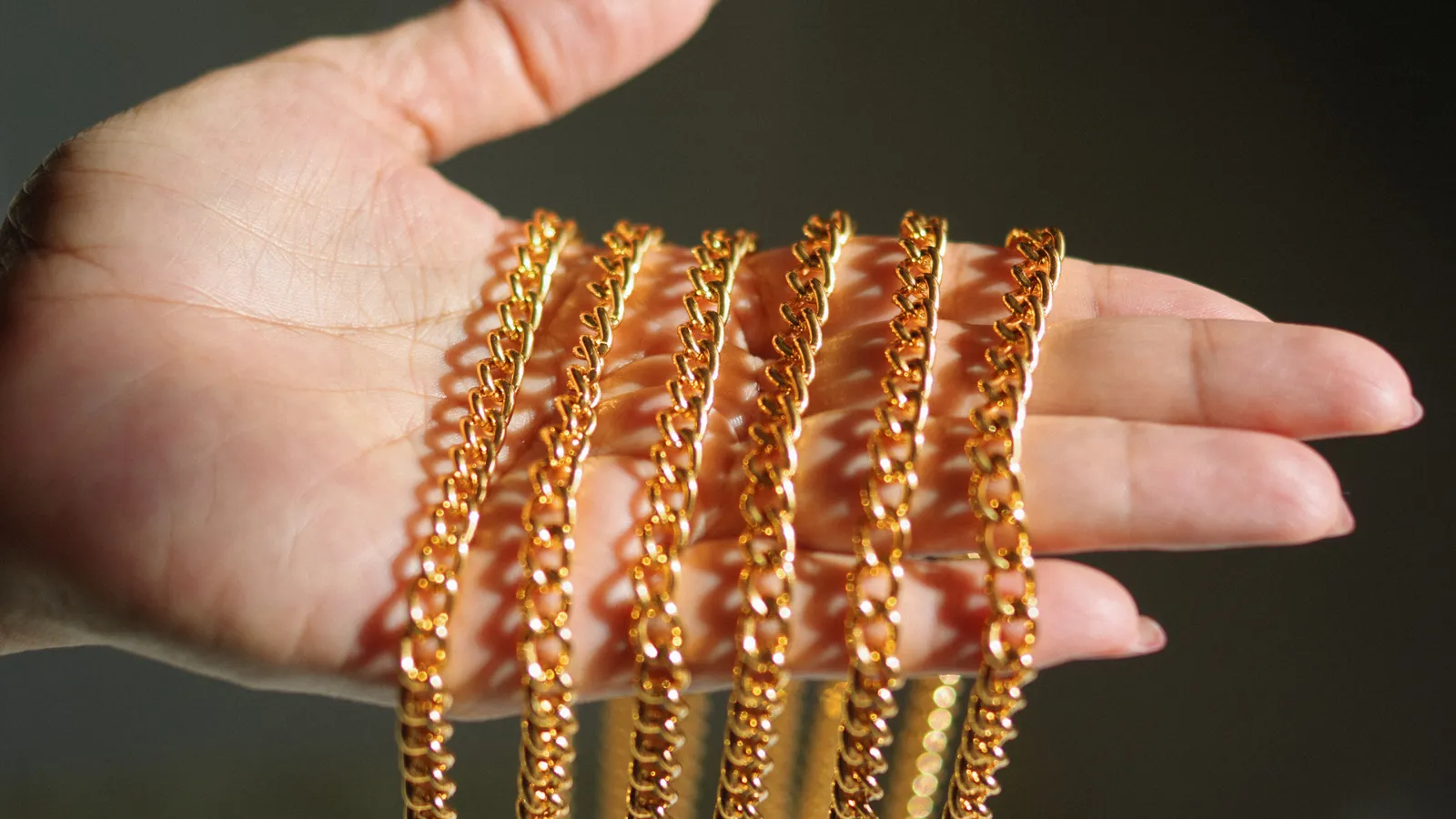
Short answer: “SAK” on a gold chain is a maker’s mark: letters that identify the company that made or sold the chain. It is not a gold purity stamp, so on its own it doesn’t prove the chain is real gold. Look for a karat stamp next to it, such as 10K, 14K or 585. If you see SAK plus a karat stamp, there’s a good chance it’s genuine, but only a test confirms it.
At a glance
| Stamp | What it means |
|---|---|
| SAK | Maker’s or brand mark |
| 10K / 417 | 10 karat gold, about 41.7% gold |
| 14K / 585 | 14 karat gold, about 58.5% gold |
| 18K / 750 | 18 karat gold, 75% gold |
| GP, GEP, HGE | Gold-plated |
| GF or 1/20 14K | Gold-filled |
What does SAK stand for?
Gold chains often carry two kinds of stamps:
- A purity (quality) mark, which says how much gold is in the metal.
- A maker’s mark, often initials or a logo, which identifies the manufacturer.
SAK is the second kind. Public trademark records list “SAK” as a jewelry mark associated with S.A. Kitsinian Inc., a jewelry company, which fits the initials. Records like these change over time, so if you want certainty, you can look it up yourself for free in the USPTO’s trademark search.
What matters for you as an owner: the letters SAK tell you who is behind the chain, not what it’s made of.
Is a gold chain stamped SAK real?
Possibly, but check the other stamps:
- SAK + 10K, 14K, 417 or 585: likely real karat gold.
- SAK + GP, GEP, HGE or RGP: plated, not solid gold.
- SAK alone, no purity mark: unknown. It could be gold, but you’d need it tested.
Keep in mind that stamps can be faked. Under the FTC’s Jewelry Guides, a karat mark should accurately describe the gold content, and federal law (15 U.S.C. § 297) requires a maker’s trademark or name on items stamped with a gold quality mark and shipped across state lines. That’s likely why SAK appears alongside the karat stamp. Counterfeiters don’t follow those rules, though, so a stamp is a clue rather than proof.
How to check if your gold chain is real
- Look at all the stamps under a magnifying glass, including the clasp and its tag.
- Try a magnet. Gold isn’t magnetic. A strong pull suggests a steel or iron core. A slight pull can come from a magnetic clasp spring, so test the chain itself. See why is my gold chain slightly magnetic.
- Check wear points. On a plated chain, a different color often shows through at the clasp and on high-contact links.
- Get it tested. A jeweler can do an acid test or, better, an XRF test, which doesn’t damage the chain.
For more ways to check, read how to spot fake gold chains.
Should you buy a chain stamped SAK?
Judge it like any other gold chain:
- Karat: 10K and 14K are the most common for chains.
- Weight in grams: chain prices track gold weight, so compare price per gram.
- Solid or hollow: hollow chains look bigger for less gold but dent easily. See what is a semi-solid gold chain.
- Seller reputation: buy from a jeweler or retailer with clear return policies and material details.
- Resale chances: if you buy secondhand, ask whether the seller will let you have it tested first.
Frequently asked questions
Does SAK mean my chain is real gold?
Not by itself. SAK identifies a maker or brand. Look for a separate purity stamp such as 10K, 14K, 417 or 585, and have it tested if you’re unsure.
Where is the SAK stamp on a chain?
Usually on the clasp, the clasp’s tag, or the end link near the clasp, often next to the karat stamp.
Is a chain worth more because it says SAK?
Generally no. Most gold chains are valued by karat and weight. A maker’s mark can matter for designer or collectible pieces, but it rarely changes the price of a standard chain.
What if my chain only has a karat stamp and no maker’s mark?
That’s common. Plenty of real gold chains carry only a purity stamp. Testing is the only way to be sure either way.