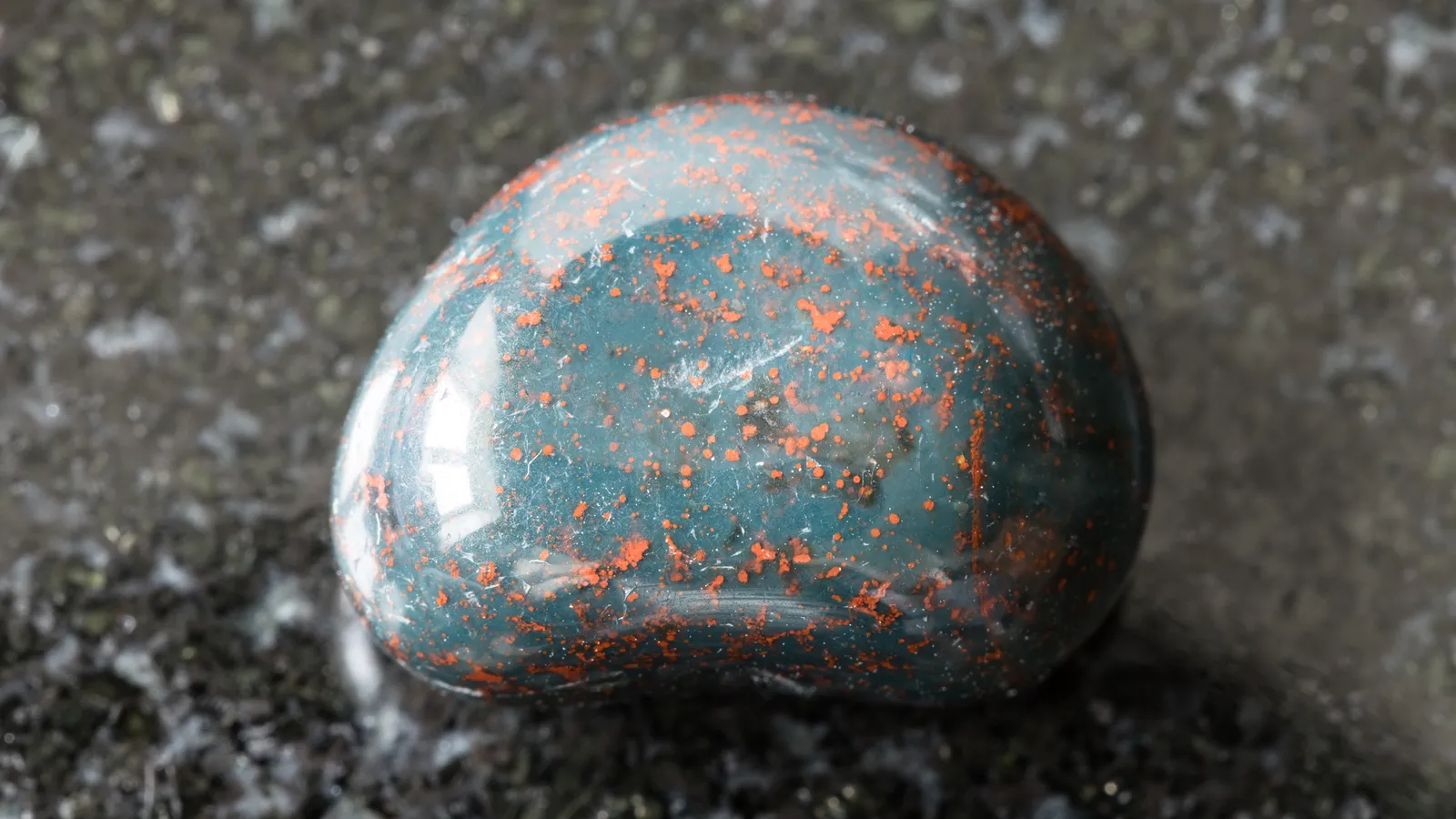
Short answer: bloodstone is an opaque, dark green form of chalcedony (a type of quartz) dotted with red spots of iron oxide, mostly hematite. It’s also called heliotrope and is the traditional birthstone for March. It’s tough, affordable and easy to care for, which makes it popular for rings, cameos, beads and men’s jewelry.
At a glance
| Property | Bloodstone |
|---|---|
| Also called | Heliotrope |
| Mineral family | Chalcedony (microcrystalline quartz) |
| Color | Dark green with red to orange spots |
| Cause of red spots | Iron oxides, especially hematite |
| Hardness | 6.5–7 on the Mohs scale |
| Birthstone | Traditional March birthstone (aquamarine is the modern one) |
| Main source today | India |
What is bloodstone made of?
Bloodstone is chalcedony: quartz made of crystals too small to see. Its deep green body color and opacity come from mineral inclusions, and the red specks are iron oxides, especially hematite.
Not every piece has lots of spots. The International Gem Society notes some bloodstones have few or none, and stones with plenty of strong red spots are usually valued more.
How did bloodstone get its name?
The stone has two names with two different stories:
- Heliotrope comes from an ancient Greek term meaning “to turn the sun.” According to GIA, people once believed that placing the stone in water would turn the sun red.
- Bloodstone comes from a later religious belief that its red markings represented the blood of Christ.
Bloodstone history and lore
Bloodstone has a long record as a carving stone. Engraved bloodstone pieces survive from the Roman Empire, and it has been used for seals, cameos and signet rings for centuries.
Over time it was credited with many powers, including strength, health and even invisibility. GIA notes that athletes today still think of it as a lucky stone for strength. These are traditions and beliefs, not proven effects.
Bloodstone as a birthstone
Bloodstone is the traditional March birthstone, while aquamarine is the modern one. If you’re shopping for a March birthday, bloodstone is a sturdier and often more affordable choice for everyday rings.
Physical properties
- Hardness: 6.5–7, so it resists everyday scratches.
- Toughness: good. The International Gem Society describes bloodstone as more durable than most gems because it has no cleavage (no tendency to split along flat planes).
- Luster: waxy to glassy when polished.
- Cut: usually cabochons, beads and carvings; occasionally faceted.
Where is bloodstone found?
GIA and the International Gem Society both name India as the main source today. Other sources include Brazil, Australia, China and the United States, among other countries.
How to judge bloodstone quality
| Factor | What to look for |
|---|---|
| Body color | Even, deep green without large gray or brown patches |
| Spots | Bright red to dark orange, well distributed |
| Polish and cut | Smooth, glossy surface with crisp carving |
| Cracks | None visible on the surface |
Watch out for look-alikes
There are no known synthetic bloodstones, but glass imitations exist. Names like “blood jasper” and “chicken-blood stone” are sometimes applied to different materials. Buy from sellers who state the material clearly.
How to care for bloodstone
GIA recommends:
- Cleaning with warm soapy water and a soft brush.
- Keeping it away from harsh chemicals and extreme heat.
- Drying it with a soft cloth.
- Storing it in soft fabric so harder gems don’t scratch it.
Stones that pair well with bloodstone
Bloodstone’s dark tone works with other earthy, opaque gems. Explore hematite rings, learn the difference between onyx and obsidian, or read about jade.
Frequently asked questions
Is bloodstone the same as heliotrope?
Yes. Heliotrope is the older name for bloodstone. GIA says it comes from an ancient Greek term meaning “to turn the sun.”
Is bloodstone expensive?
No. It’s generally an affordable gem. Stones with deep red, well-spread spots and fine carving or polishing cost more.
Is bloodstone the same as blood jasper or hematite?
No. Those names are sometimes used loosely, but hematite is a metallic iron oxide and “blood jasper” can refer to different red or spotted stones. Check the listing’s material details.
Can bloodstone get wet?
Yes. It’s a durable quartz-family stone that can be cleaned with warm soapy water. Just avoid harsh chemicals and extreme heat.