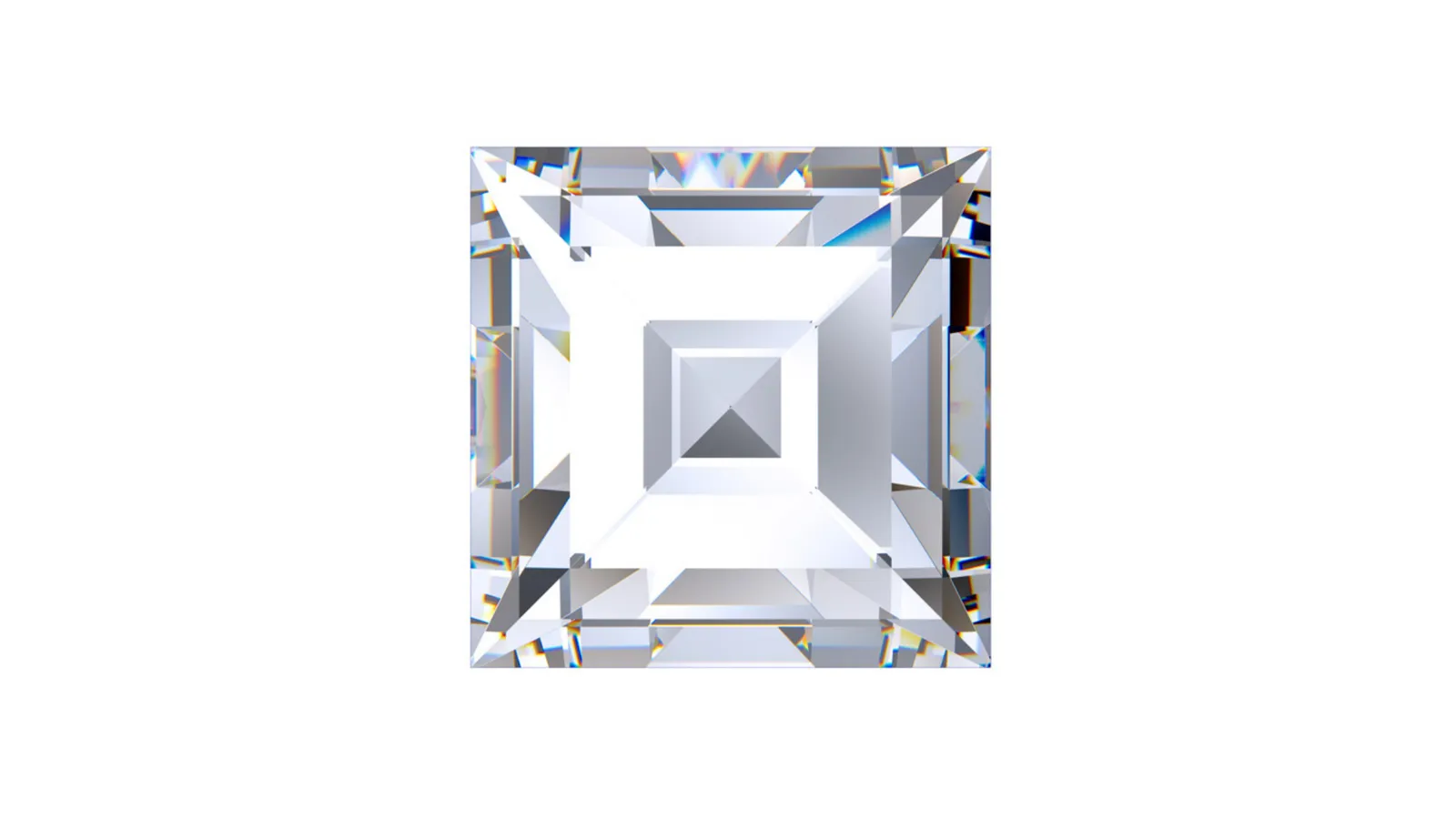
Short answer: a carré cut diamond is a square diamond cut in the step-cut style, with sharp 90-degree corners and rows of straight, parallel facets that look like concentric squares from above. “Carré” is French for square. It looks clean and architectural, like a square version of an emerald cut, and it shows a diamond’s clarity more than brilliant shapes do.
At a glance
| Carré cut | |
|---|---|
| Shape | Square |
| Facet style | Step cut (straight, parallel facets) |
| Corners | Sharp, not clipped |
| Look | Hall-of-mirrors flashes, glassy depth |
| Hides inclusions? | Poorly |
| Suggested clarity | VS2 or higher, checked by eye |
| Common uses | Accent stones, channel-set bands, minimalist solitaires |
How a carré cut is faceted
Like the emerald cut and baguette, the carré uses step facets: long, flat facets that run parallel to the edges and step down toward the center. From the top you see a series of nested squares. It doesn’t have the dozens of small triangle facets of a brilliant cut, so it flashes in broad planes of light instead of glittering.
Read what is a step cut diamond for how this family of cuts works.
Carré vs similar square cuts
| Cut | Facet style | Corners | Look |
|---|---|---|---|
| Carré | Step cut | Sharp, square | Clean, nested squares |
| Asscher | Step cut | Clipped (octagonal look) | Deep, “windmill” pattern |
| Princess | Brilliant | Sharp, pointed | Lots of sparkle |
| Baguette | Step cut | Sharp | Long, narrow rectangle; mostly used as side stones |
If you want a square with plenty of sparkle, a princess is the better match. If you want the calm, mirror-like look of a step cut, choose a carré or Asscher.
What to look for when buying a carré cut
Clarity
Step cuts act like a window into the stone, so inclusions are easy to see. GIA suggests VS2 or higher clarity for step cuts like the emerald and Asscher, and the same thinking applies to carrés. Always look at the stone or a magnified video; don’t rely on the grade alone. See what are eye-clean diamonds.
Color
Large, open facets also show body color more clearly. G or better looks crisp in white metal. In yellow or rose gold, you can often go a little lower.
Symmetry
The steps should be evenly spaced and the square truly square. Uneven steps or a slightly rectangular outline are easy to notice in such a simple design.
Corners
Sharp corners are the carré’s weak spot. Check them under magnification for chips before you buy.
Best settings for a carré cut
Protect the corners
Square, pointed corners can chip if they take a knock. Choose a setting that covers or guards each corner.
- V-prongs or corner prongs: hold and shield each corner while showing most of the stone.
- Bezel: a metal rim around the whole edge gives the most protection and a sleek, modern look.
- Channel setting: carrés sit edge to edge between two metal walls, a popular choice for eternity and wedding bands.
- Halo: a frame of small diamonds adds sparkle around the calm center, and can make it look larger.
See engagement ring settings for more on each style.
Pros and cons
Pros
- Crisp, minimalist, architectural look.
- Pairs well with channel and bezel settings.
- Different from the usual round or princess.
Cons
- Shows inclusions and color more than brilliant cuts.
- Less sparkle than brilliant shapes.
- Sharp corners need protection.
- Fewer stones to choose from, especially in larger sizes.
Should you buy a carré cut diamond?
It’s a strong choice if you love clean lines and an Art Deco or modern feel, and you’re willing to prioritize clarity. If sparkle matters most, look at a princess cut or radiant cut instead.
Frequently asked questions
Is a carré cut the same as an Asscher cut?
No. Both are square step cuts, but the Asscher has clipped corners that make it look octagonal. A carré keeps sharp, square corners.
Is a carré cut diamond more expensive?
Not usually per carat. Fancy shapes generally cost less than rounds. Carrés are often small and used as accent stones, so they’re typically affordable, but larger, high-clarity ones can be harder to find.
What does carré mean?
It’s French for “square,” which describes the shape.
Are carré cut diamonds used in eternity bands?
Yes. Their straight sides let them sit edge to edge in a channel setting, which makes a smooth, continuous line of diamonds.