Short answer: “composite diamond” usually means a group of small diamonds set tightly together so they look like one larger diamond from a distance. It’s a way to get a big look for less money. The term is also sometimes used for assembled stones, made by gluing or fusing pieces together, so always ask the seller exactly which one they mean.
At a glance
| Composite (cluster) | Single diamond (solitaire) | |
|---|---|---|
| What it is | Several small diamonds set as one shape | One diamond |
| Carat weight shown | Total weight of all stones | Weight of the one stone |
| Price for the same total weight | Much lower | Much higher |
| Sparkle | Lots of small flashes | Larger, bolder flashes |
| Resale value | Low | Better (still below retail) |
| Upkeep | Check for loose stones | Check prongs |
What a composite diamond usually means
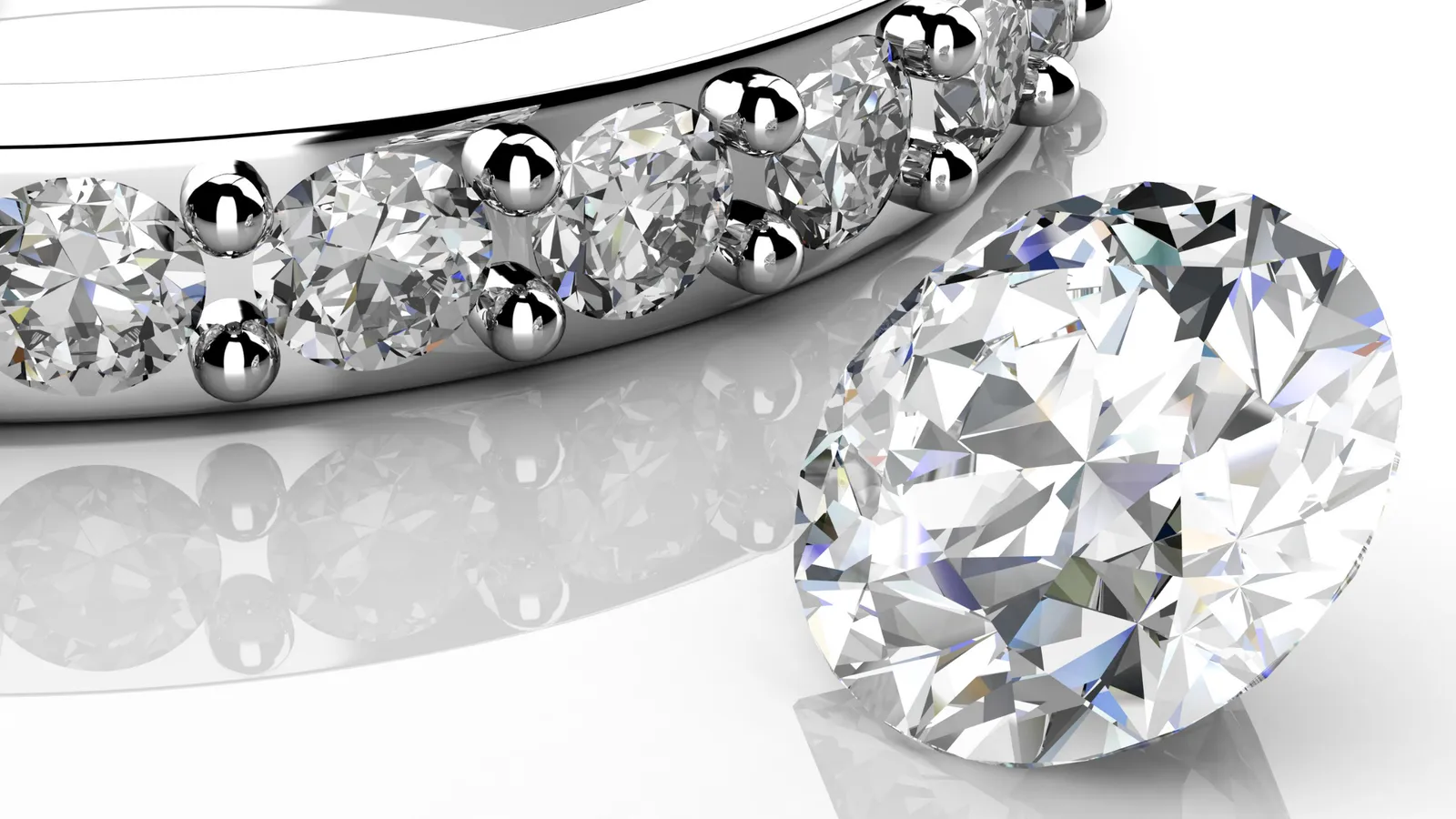
In everyday jewelry shopping, a composite diamond (also called a cluster or illusion setting) is a set of small round, princess or baguette diamonds arranged closely so they read as one bigger stone. Common designs include:
- A round cluster: seven or more small rounds forming a circle that mimics a round brilliant.
- A flower cluster: a center stone with “petals” around it.
- Shaped composites: small stones arranged into a princess, oval, pear or heart outline.
- Invisible-set squares: princess cuts set edge to edge with no visible metal. See what are invisible-set diamonds.
The appeal is simple: small diamonds cost far less per carat than large ones, so a cluster gives you a large face-up size on a smaller budget.
The other meaning: assembled stones
GIA describes assembled or composite stones as gems made by gluing or fusing two or more pieces together. A doublet has two pieces; a triplet has three. Some are used to imitate more valuable gems, and others (like many opal doublets) are a practical way to use thin natural material.
If someone offers you a “composite diamond” that looks like one stone, ask whether it’s assembled and what each part is made of. Under the FTC’s Jewelry Guides, sellers shouldn’t describe something as a “diamond” unless it is one, and lab-grown diamonds must be clearly identified as lab-grown.
How carat weight works on composite pieces
This is where shoppers get caught out. A composite ring tagged “1 ct” almost always means 1 carat total weight (CTTW) of all the little diamonds combined, not a single 1-carat stone.
| Label | What you’re getting |
|---|---|
| 1 ct solitaire | One diamond weighing about 1 carat |
| 1 ct TW cluster | Many smaller diamonds adding up to about 1 carat |
Because a single large diamond is much rarer, it costs many times more than the same weight in small stones. Read what CTTW means for diamonds before comparing prices.
Pros and cons of composite diamonds
| Pros | Cons |
|---|---|
| Big look for a modest budget | Up close it’s clearly many stones |
| Lots of sparkle from many facets | More prongs to snag and check |
| Lots of design options (flowers, shapes) | Small stones can come loose |
| Small stones are easy and cheap to replace | Low resale value |
| Spreads risk: one chip doesn’t ruin the piece | Harder to clean between stones |
Composite vs. cubic zirconia vs. lab-grown
If you want a big look for less, you have a few options:
- Composite: real natural (or lab-grown) diamonds, just small ones.
- Lab-grown solitaire: a single real diamond, grown rather than mined, and typically much cheaper than a natural one of the same size.
- Simulant (cubic zirconia, moissanite): not diamond at all. Compare them in the best diamond simulants.
How to tell if a ring is composite
- Look closely or use a loupe. You’ll see separate stones and the metal or seams between them.
- Read the paperwork. “TW” or “CTTW” next to the weight usually means multiple stones.
- Ask for a breakdown. A good jeweler will tell you the number of stones and the weight of the largest.
Caring for a composite piece
- Check it every few months. Gently shake the piece near your ear; a rattle can mean a loose stone. A jeweler can check and tighten prongs for little or nothing.
- Clean gently. Warm water, a drop of mild dish soap and a soft toothbrush lift grime from between the stones.
- Avoid hard knocks. Small stones in many prongs are more likely to work loose than one well-set diamond.
Is a composite diamond worth it?
If you love a large, sparkly look and value design over resale, a composite piece is a smart way to stretch your budget. If you want a stone that holds its identity and value better, put the money toward a smaller solitaire or a lab-grown diamond instead. Still deciding on style? See are diamond cluster rings tacky.
Frequently asked questions
Are composite diamonds real diamonds?
In the usual cluster sense, yes: every stone is a real diamond, just smaller. The term can also be used for assembled stones, which may contain glass or other materials, so ask exactly what the piece is made of.
Is a 1-carat composite the same as a 1-carat solitaire?
No. “1 carat” on a composite piece is the total weight of all the small stones. A single 1-carat diamond is rarer and typically costs far more.
Do composite diamond rings hold their value?
Not well. Small diamonds are plentiful, so a composite piece usually resells for much less than a solitaire of the same total weight. Buy it because you love the look.
Can a composite ring be upgraded later?
Sometimes. A jeweler can often replace the cluster head with a setting for a single stone, but it depends on the ring’s design. Ask before you buy if upgrading matters to you.