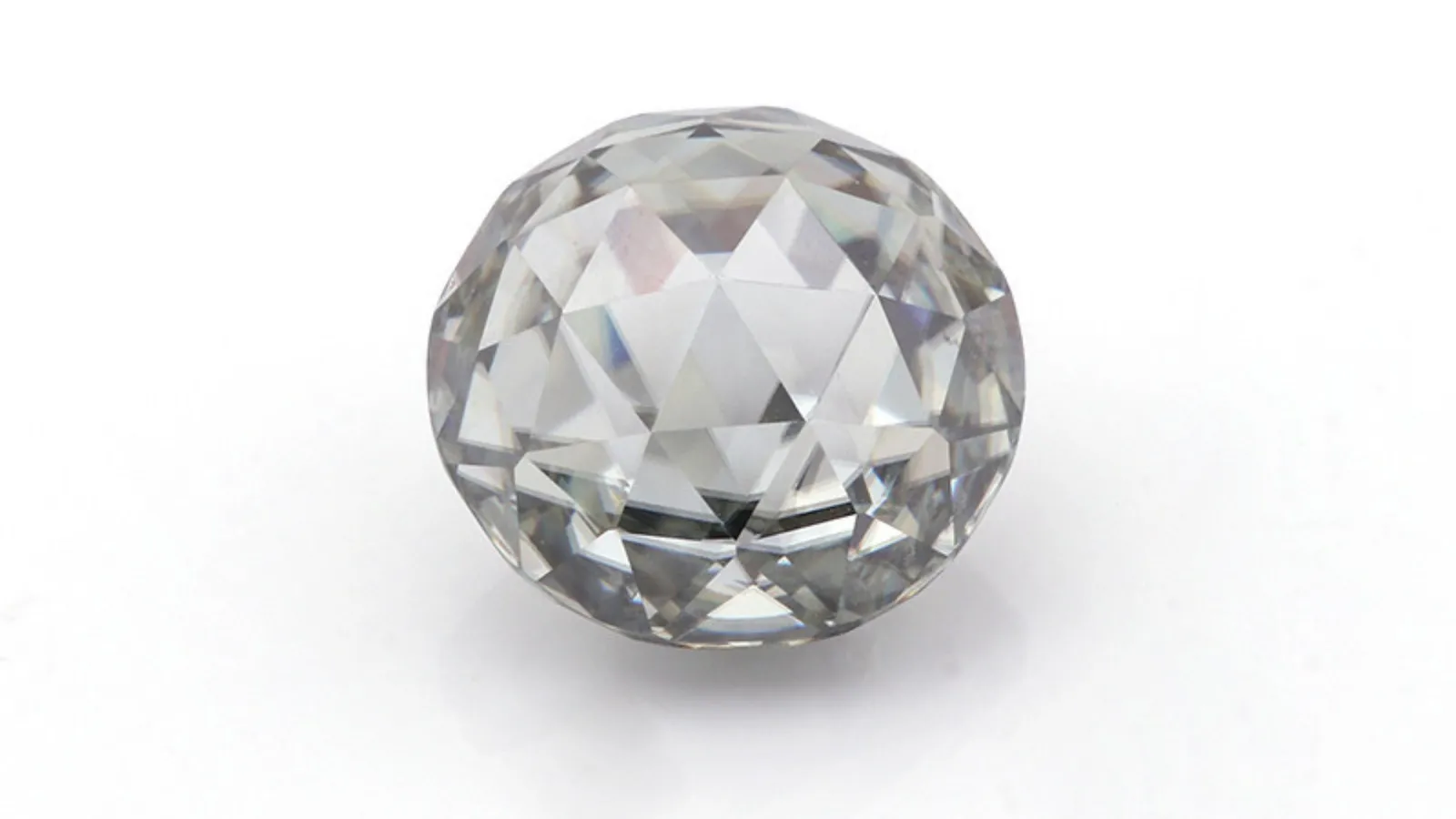
Short answer: a double rose cut diamond is a rose cut with facets on both sides. A regular rose cut has a flat back and a domed, faceted top. A double rose cut is domed and faceted on the bottom too, like two rose cuts joined back to back. It’s an antique style with a soft, glowing sparkle, and it looks lovely in open-backed pendants and earrings where both sides show.
At a glance
| Rose cut | Double rose cut | Modern round brilliant | |
|---|---|---|---|
| Top | Domed, triangular facets | Domed, triangular facets | Flat table, many facets |
| Bottom | Flat | Domed, triangular facets | Pointed pavilion |
| Sparkle | Soft, glassy flashes | Soft flashes from both sides | Bright fire and brilliance |
| Era | From the 1500s | Historic, also made today | 20th century onward |
How a rose cut works
The rose cut appeared in the 16th century. Its facets are triangles arranged around a central point, rising into a dome. The bottom is flat. There’s no big top facet (table), which gives rose cuts their gentle, candlelit look.
Over time cutters added rows of facets. GIA describes the classic forms as a dome with six triangular facets at the center and another layer of 6, 12 or 18 facets below it, the patterns known as the Antwerp, half-Dutch and full-Dutch roses.
What makes it a “double” rose cut?
A double rose is one stone with the rose pattern on both its crown (top) and pavilion (bottom). Glossaries describe it as two rose cuts placed base to base. The result:
- Symmetrical profile: it looks like a faceted lens or bead.
- No flat back: it can’t sit flat in a closed-back setting the way a single rose can.
- Sparkle from both sides: best in settings that let light and eyes reach the back.
Double rose cuts were popular in 19th- and early 20th-century pendants and earrings. The famous Sancy and Florentine diamonds are often cited as historic examples.
Double rose vs. other antique cuts
| Cut | Key feature |
|---|---|
| Single rose | Flat bottom, domed top |
| Double rose | Domed top and bottom |
| Old mine | Cushion-shaped early brilliant, high crown, small table |
| Old European | Round early brilliant, small table, large culet |
If you love the antique look but want more sparkle, compare the old European cut and old mine cut.
Pros and cons of a double rose cut
Pros
- Distinctive, romantic vintage look
- Beautiful from every angle in drop earrings and pendants
Cons
- Less brilliance and fire than modern cuts
- Inclusions can be easier to see without a busy facet pattern to hide them
- Harder to find, especially matched pairs
- Needs a setting that suits a stone with no flat back
Buying and setting tips
- Choose open-back or bezel-set drop styles to show off both sides.
- Check clarity carefully. With large facets and no table to break up the view, inclusions may be visible. See our guide to diamond inclusions.
- Ask whether it’s antique or newly cut. Both exist. Antique stones may show wear or slightly uneven facets, which is part of their charm.
- Get the stone’s weight and measurements in writing, since many old rose cuts aren’t graded by major labs.
Want to know how facets shape sparkle in general? Read what facets on a diamond are.
Frequently asked questions
Is a double rose cut the same as an old mine cut?
No. An old mine cut is an early brilliant with a pointed or near-pointed pavilion and a cushion outline. Rose cuts have triangular facets and no table.
Does a double rose cut sparkle like a round brilliant?
No. It gives softer, larger flashes and a glassy, glowing look rather than the bright fire of a modern brilliant.
Is a double-cut diamond the same thing?
Not always. Some sellers use “double cut” for a stone with a brilliant on one side and a rose cut on the other. Ask the seller to describe both sides.
Are double rose cuts valuable?
It depends on age, size, quality and condition. Genuine antique stones can attract collectors, but there is no simple price rule, so get an appraisal for anything significant.