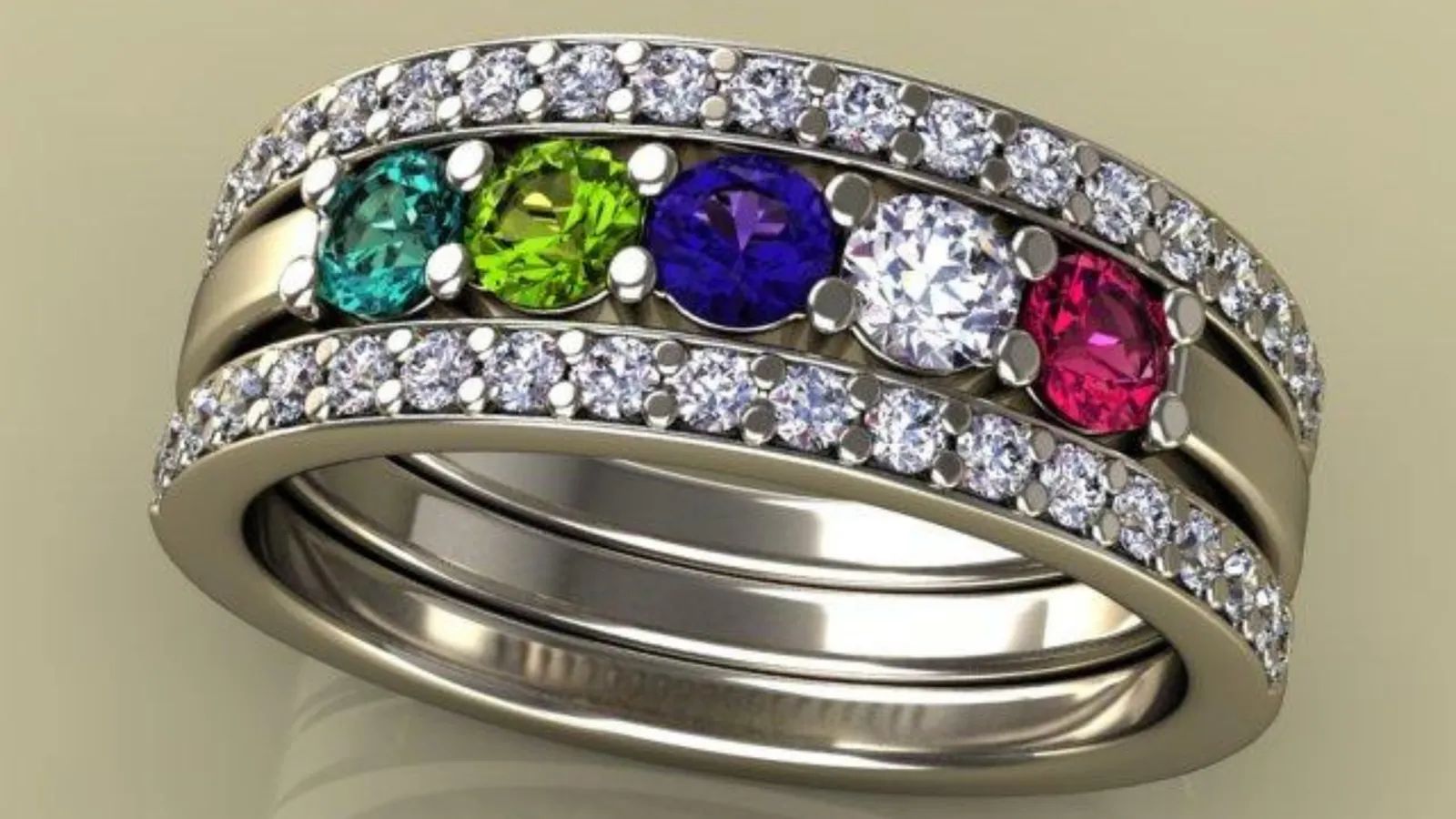
Short answer: a mother’s ring is a ring set with one birthstone for each of a mother’s children. It’s a sentimental gift, often given for Mother’s Day, a birthday or a new baby, and it can be anything from a simple band of small stones to a statement piece. There are no strict rules about how it looks or which hand it goes on.
Quick facts
- What it shows: one birthstone per child, sometimes with names or birth dates engraved
- Common metals: yellow, white or rose gold; sterling silver
- Which finger: whichever you like; the right ring finger is a popular choice
- Typical stones: real or lab-created gems, or simulated stones in budget versions
What does a mother’s ring mean?
It’s a way of carrying your children with you. Each stone stands for a child, so the ring tells a small family story at a glance. Some families also add a stone for the mother herself, a partner, or grandchildren.
Popular mother’s ring designs
- Row band: stones set side by side across the top. Easy to wear every day.
- Stackable rings: one slim ring per child. Easy to add to later.
- Cluster or halo: birthstones grouped around a center stone or diamond.
- Infinity or swirl: stones set along a twisting band.
- Engraved band: fewer stones, with names or dates on the inside or outside.
- Family tree or heart motifs: more decorative styles for occasional wear.
How to design a mother’s ring
- List the stones. Use each child’s birth month to choose a birthstone. Order them by age, left to right, if you like.
- Choose real, lab-created or simulated stones. Real and lab-created gems cost more and last longer. Simulated stones are glass or cubic zirconia in birthstone colors and cost much less.
- Pick a metal. 10K or 14K gold is durable for daily wear. Sterling silver is cheaper but scratches and tarnishes more.
- Think about durability. Softer stones like opal (October) and pearl (June) can get scratched in an everyday ring. A protective bezel setting helps.
- Add engraving. Names, dates or a short message inside the band make it personal without changing the look.
How to wear a mother’s ring
- Right ring finger: a common choice, since the left is often taken by an engagement ring and wedding band.
- Stacked with wedding rings: a slim band can sit alongside a wedding set. Check that the widths look good together.
- Index or middle finger: works well for wider or bolder designs.
- On a necklace: some people thread it onto a chain, especially if it no longer fits.
For more ideas on combining pieces, see how to wear multiple diamond rings.
Tips before you buy
- Get the ring size right. Many mother’s rings have stones around the band, which makes resizing harder or impossible later. See how to make a ring smaller for what’s possible.
- Check exactly what the stones are. Listings should say “natural,” “lab-created” or “simulated.” If it doesn’t say, ask.
- Ask about adding stones. If more children or grandchildren could come, pick a design that can grow.
- Look at the setting quality. Small stones in thin prongs can come loose. Stones set flush or in bezels are more secure.
- Plan for the timeline. Custom pieces often take a few weeks, so order well before a holiday.
Frequently asked questions
Who usually buys a mother’s ring?
Often a partner or the children give it, commonly for Mother’s Day, a birthday or the birth of a child. Many mothers also buy one for themselves.
Can you add stones to a mother’s ring later?
Some designs can be modified by a jeweler, but it isn’t always possible. If you may add children or grandchildren later, choose a design built to expand, such as a stackable set or charm style.
Can a mother’s ring include stepchildren or children who have passed away?
Yes. It’s a personal piece, and many families include every child they want to honor.
Is there a grandmother’s ring?
Yes. The idea is the same, with birthstones for grandchildren, sometimes alongside the children’s stones.