Short answer: ruthenium is a rare, hard metal from the platinum family. In jewelry you’ll meet it in two ways: as a thin plating that gives silver or gold a dark gray to black finish, and as a small alloy ingredient that makes platinum harder. Ruthenium-plated pieces look striking but the finish slowly wears, so expect to replate rings every so often.
At a glance
| Ruthenium plating | Platinum-ruthenium alloy | |
|---|---|---|
| What it is | Thin dark layer over another metal | Platinum mixed with a little ruthenium |
| Color | Gunmetal gray to black | Bright white (platinum color) |
| Typical base | Sterling silver, gold, brass | Mostly platinum (e.g. 950 Pt) |
| Wears off? | Yes, gradually | No, it’s solid metal |
| Stamp to look for | Often 925 or 14K plus “black” in the listing | 950 Pt/Ru, Plat/Ru |
What is ruthenium?
Ruthenium is element 44, one of the six platinum group metals (PGMs) along with platinum, palladium, rhodium, iridium and osmium. According to the Royal Society of Chemistry:
- It was discovered in 1844 by Karl Karlovich Klaus.
- The name comes from Ruthenia, the Latin name for Russia.
- It’s one of the rarest metals on Earth, usually found alongside other platinum metals.
- It’s one of the most effective hardeners for platinum and palladium, and it’s used in some jewelry as an alloy with platinum.
Ruthenium plating: the dark finish
Most “ruthenium jewelry” you’ll see online is ruthenium-plated. A jeweler electroplates a thin layer of ruthenium over a finished piece, much like the rhodium plating on white gold. Jewelry suppliers sell black ruthenium plating solutions specifically for this.
Why designers use it:
- Color. It gives a deep gray or near-black look that’s hard to get from metal alone.
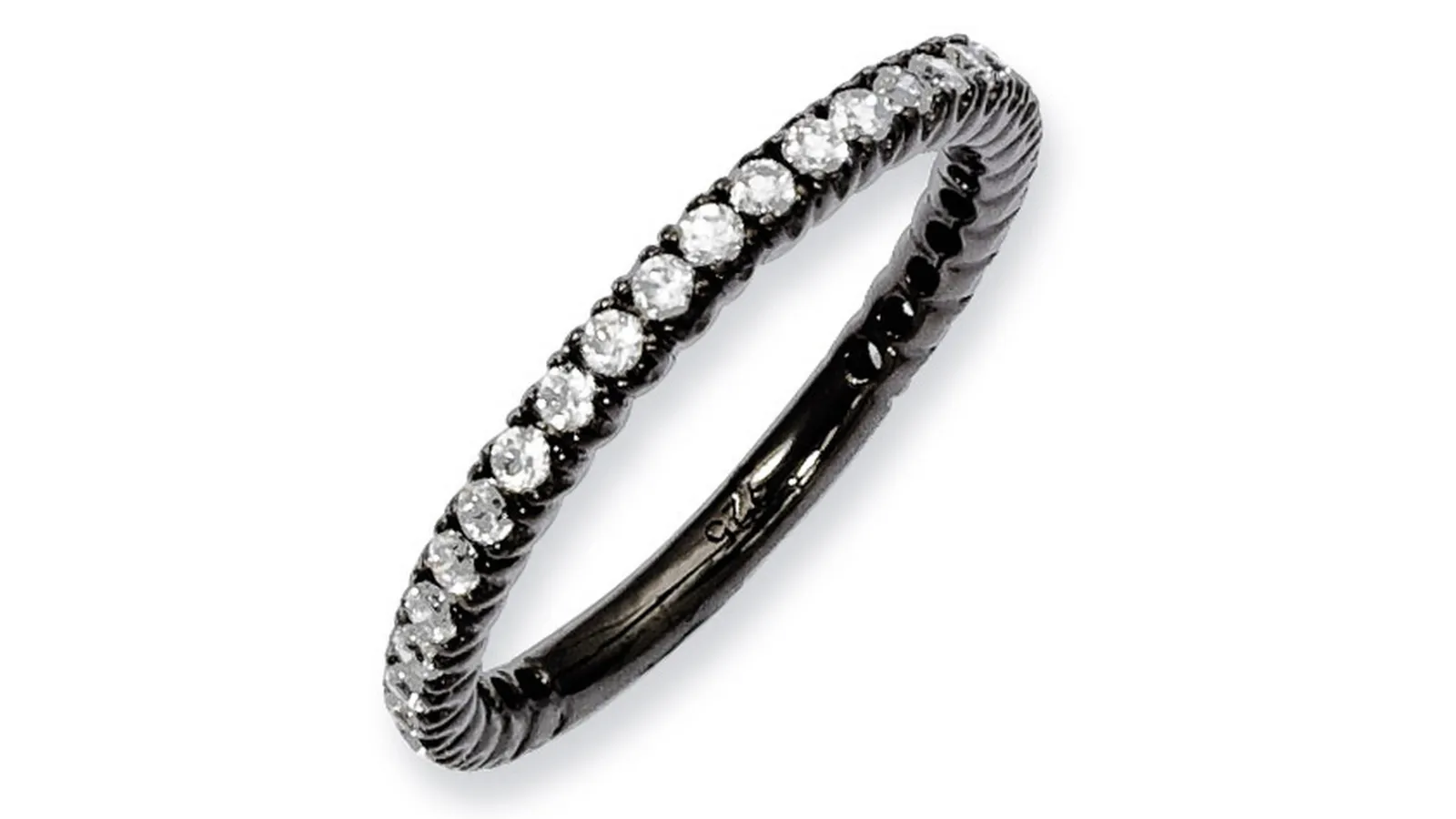
- Contrast. White diamonds and cubic zirconia pop against a dark setting, as in the black eternity band pictured above.
- Accent work. Jewelers often plate just part of a piece to highlight engraving or texture.
How long does ruthenium plating last?
There’s no fixed lifespan. It depends on the plating thickness, the piece and how you wear it:
- Earrings and pendants: can keep their finish for years.
- Rings and bracelets: wear fastest, especially on the palm side and edges.
- Signs it’s wearing: silver or gold peeking through at edges and high points.
When that happens, a jeweler can clean, strip and replate it. This is the same idea as how long rhodium plating lasts on white gold.
Ruthenium in platinum jewelry
You may see 950 Pt/Ru or Plat/Ru inside a platinum ring. That means the ring is 95% platinum with ruthenium making up most of the rest. Ruthenium hardens the platinum, which helps it resist dents.
The FTC Jewelry Guides allow Ru. or Ruth. as the abbreviation for ruthenium, and set rules for when an item can be called “platinum” based on how much pure platinum it contains. A piece with at least 950 parts per thousand pure platinum can simply be called platinum.
Unlike plating, this alloy is the same all the way through, so there’s nothing to wear off. It will still develop the soft sheen described in our guide to platinum patina.
Pros and cons of ruthenium-plated jewelry
Pros
- Unusual dark color that suits modern and men’s designs
- Hard surface that resists light scratching better than bare silver
- Makes diamonds and white stones stand out
Cons
- Plating eventually wears, especially on rings
- Replating is an ongoing cost
- Can’t be resized or repaired without redoing the finish
How to care for ruthenium-plated jewelry
- Clean gently. Use warm water, a drop of mild dish soap and a soft cloth. Skip brushes on plated surfaces.
- Avoid abrasives. Polishing cloths with compounds and silver dips can strip the plating.
- Take it off for rough work. Gym sessions, gardening and cleaning wear the finish fastest.
- Keep it away from chemicals. Chlorine and harsh cleaners can damage the plating and the metal beneath.
- Store it separately. A soft pouch stops diamonds and harder metals scratching it.
If you have sensitive skin, check what the base metal is before buying. Our guide to the best jewelry for sensitive skin covers which metals are least likely to cause reactions.
Frequently asked questions
Is ruthenium jewelry valuable?
The plating itself adds little value because the layer is extremely thin. What you're paying for is the base metal (often sterling silver or gold), any stones, and the dark finish.
Does ruthenium plating wear off?
Yes, gradually. Rings and bracelets wear fastest because they rub against surfaces. A jeweler can strip and replate the piece when the base metal starts to show.
Is ruthenium safe to wear?
Ruthenium metal plating is widely used on jewelry. The Royal Society of Chemistry notes that one ruthenium compound, ruthenium(IV) oxide, is highly toxic, but that isn't what a finished plated surface is. If you react to a piece, the cause is more likely a base metal like nickel; see a doctor if a rash persists.
What does Ru mean on platinum jewelry?
It shows ruthenium is part of the alloy. Under the FTC Jewelry Guides, Ru or Ruth. is the accepted abbreviation, often seen in marks like 950 Pt/Ru on platinum rings.