Short answer: there’s no reliable way to prove a diamond is real at home. GIA says popular tricks like the fog, newspaper and sparkle tests give inconsistent results, and the sandpaper test can damage jewelry. The dependable options are a jeweler with proper testing equipment, a grading report from a reputable lab, or both.
At a glance
| Method | Reliable? | Why |
|---|---|---|
| Fog (breath) test | No | Results vary with humidity; lab-grown and natural react the same |
| Newspaper / read-through test | No | Depends on lighting, cleanliness and setting |
| Sparkle check | No | Many simulants sparkle; cut affects sparkle |
| Loupe for inclusions | No (for most people) | Imitations can have inclusions; some diamonds don’t |
| Sharp facet edges | No | Lab-grown diamonds and many imitations are sharp too |
| Sandpaper scratch | Never | Destructive; moissanite can resist it |
| Thermal tester | Partly | Rules out glass and cubic zirconia, not moissanite |
| Jeweler with dual tester | Good | Separates diamond from moissanite |
| Gem lab report | Best | Confirms diamond, natural vs lab-grown, and grades |
What counts as a “real” diamond?
The FTC defines a diamond as a mineral made essentially of pure carbon crystallized in the cubic (isometric) system, with a hardness of 10. Both natural and lab-grown diamonds meet that definition. A lab-grown diamond isn’t fake; it’s a diamond from a different source, and it must be disclosed as lab-grown.
A fake (or simulant) is something that only looks like diamond, such as:
- Cubic zirconia (CZ) – see cubic zirconia vs lab diamond
- Moissanite – see does moissanite pass a diamond tester?
- White sapphire, glass or crystal
Why most at-home tests don’t work
GIA reviewed the common home tests and labeled them myths:
- Fog test. Breathing on a stone and watching how fast the fog clears can’t be reproduced reliably, humidity affects it, and lab-grown and natural diamonds behave exactly the same.
- Newspaper test. Whether you can read print through a stone depends on its cut, how clean it is, the lighting and how it’s mounted.
- Sparkle. Plenty of simulants sparkle brightly, and a dirty or poorly cut diamond may not.
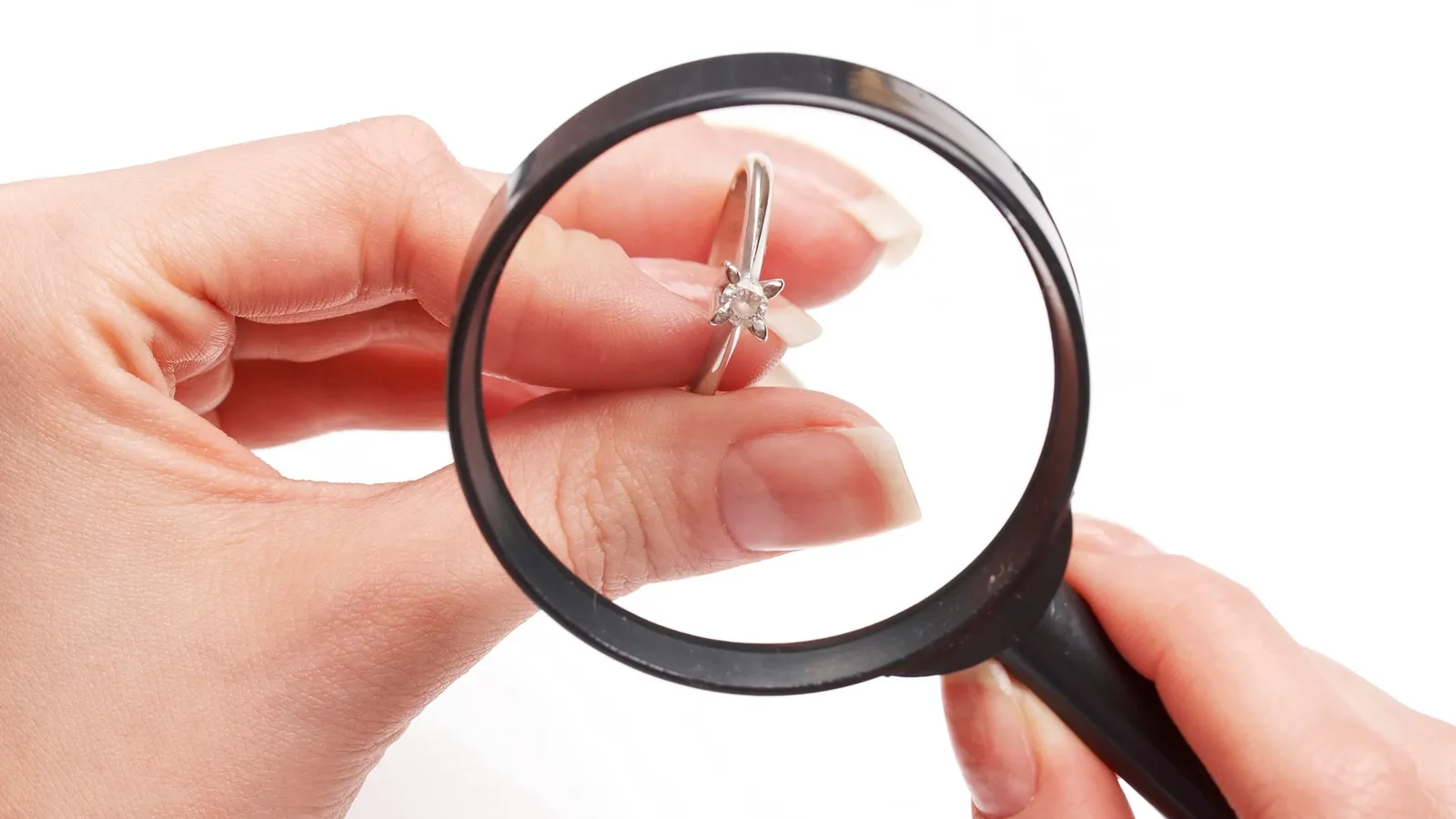
- Loupe inspection. Most people find it hard to use a loupe properly, imitations can have inclusions, and some diamonds have none visible.
- Sharp edges. Lab-grown diamonds and most imitations also have crisp facet edges, while old diamonds can have worn ones.
- The setting. Real diamonds are sometimes set in silver, and cheap stones can be set in gold. The metal alone proves nothing.
Never use the sandpaper or scratch test
GIA calls the sandpaper test destructive and says it should never be used. It can scratch the metal, damage softer stones like cubic zirconia, and still won’t separate diamond from moissanite. The same goes for hitting or heating a stone to “test” it.
What actually works
1. Have a jeweler test it
A trained jeweler can check the stone in minutes:
- A thermal tester separates diamond and moissanite from cubic zirconia and glass, because diamond and moissanite conduct heat very well.
- A dual or multi tester also measures electrical conductivity, which can separate diamond from moissanite.
- Some jewelers have screening devices that flag stones that may be lab-grown for further lab testing.
Learn more in how does a diamond tester work?
2. Get a grading report
GIA says sending a stone to a reputable gemological lab is the safest way to determine whether it’s natural or synthetic. A GIA report confirms the stone is diamond, states whether it’s natural or laboratory-grown, grades its 4Cs and notes known treatments. Your jeweler can usually handle shipping and insurance. See what is a GIA diamond?
3. Check an existing report
If your diamond already has a GIA report, enter the number on GIA’s Report Check site and make sure the details (shape, weight, measurements) match your stone. Many reports correspond to a tiny laser inscription on the diamond’s girdle that a jeweler can show you. See how to read a GIA diamond certificate.
When to get a diamond checked
- You inherited a ring and don’t know what it is.
- You’re buying a pre-owned diamond from a private seller.
- You’re insuring a piece and need documentation.
- Something about the stone looks different after a repair or cleaning.
If you’re comparing alternatives, our guide to the best diamond simulants explains how CZ, moissanite and white sapphire differ.
Frequently asked questions
Is a lab-grown diamond a fake diamond?
No. A lab-grown diamond is real diamond with the same chemistry and properties as a mined one. It is a different origin, not an imitation, and must be disclosed as lab-grown.
Can a diamond tester tell moissanite from diamond?
A basic thermal tester can’t, because both conduct heat well. A dual tester that also checks electrical conductivity can usually separate them.
Can a home test tell if my diamond is natural or lab-grown?
No. Natural and lab-grown diamonds react the same to every home test. Only a gem lab can tell them apart reliably.
How do I check a GIA report is genuine?
Enter the report number on GIA’s Report Check website. Many GIA-graded diamonds also have the report number laser-inscribed on the girdle, which a jeweler can show you under magnification.