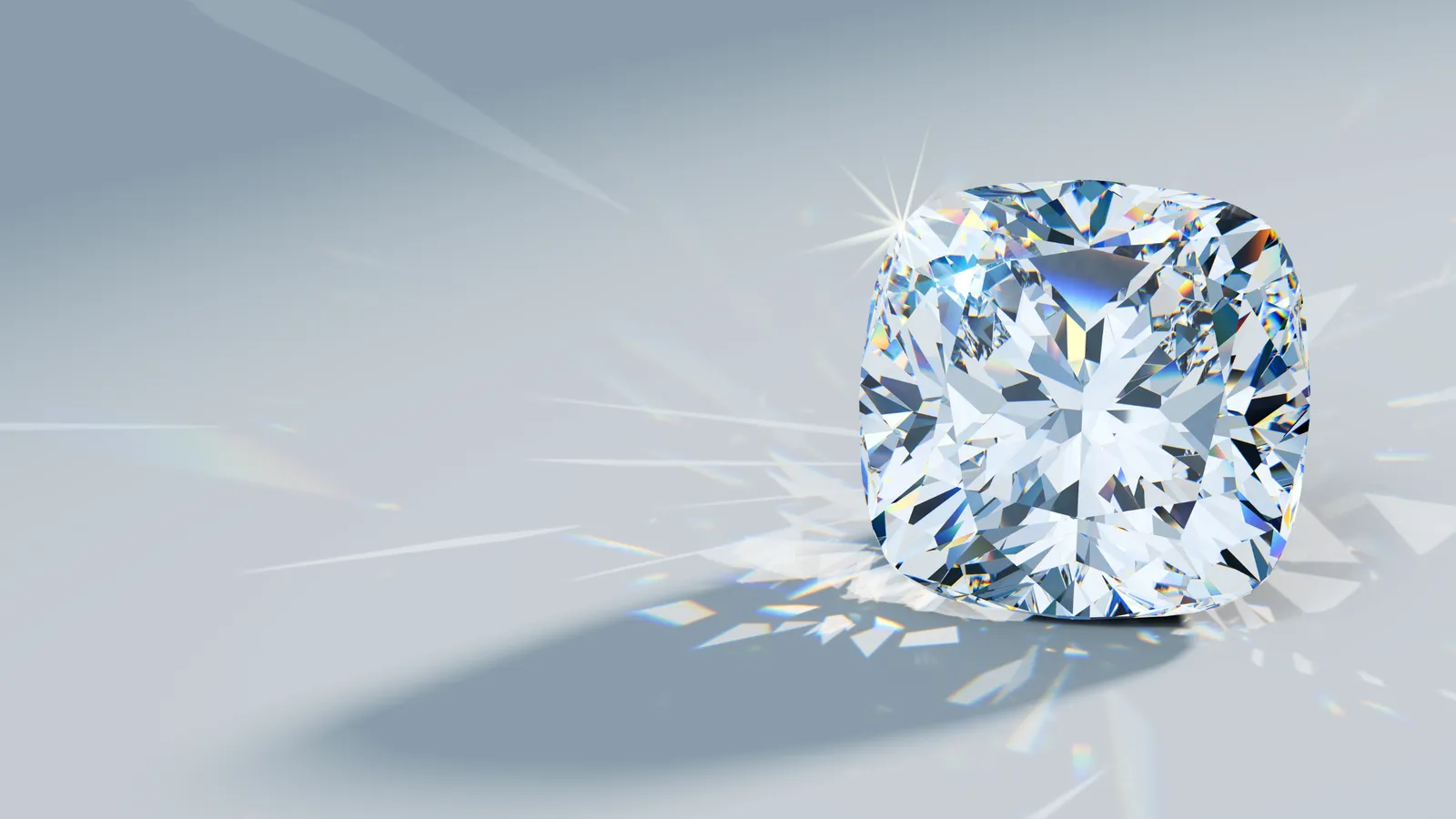
Short answer: a cushion cut diamond is a square or slightly rectangular stone with rounded corners and gently curved sides, a bit like a pillow. It’s a brilliant-style cut, so it sparkles, and it grew out of the antique old mine cut. It’s popular for engagement rings because it looks soft and vintage while still being lively.
At a glance
| Cushion cut | |
|---|---|
| Outline | Square to rectangular, rounded corners, curved sides |
| Sparkle style | Brilliant; either bold flashes or “crushed ice” |
| Ancestor | The old mine cut (1700s onward) |
| Corners | Rounded, so less prone to chipping |
| Best settings | Solitaire, halo, vintage-style, three-stone |
What does a cushion cut look like?
GIA describes cushion cuts as square or squarish-rectangular shapes with curved sides and either rounded or pointed corners. A well-cut cushion has sides and corners that mirror each other, so the outline looks balanced.
The facets underneath are usually arranged in a brilliant pattern, with four or eight kite-shaped main facets on the bottom half. When a cutter adds extra facets, the stone is called a modified cushion brilliant.
Where did the cushion cut come from?
The cushion cut descends from the old mine cut, which dates to the 1700s and was named after the Brazilian mines of the era. Old mine cuts were cut by hand to save as much rough diamond as possible, which gave them a chunky, soft-cornered outline.
Modern cushions keep that outline but use updated facet patterns for more brightness. If you love the antique look, read about the old mine cut diamond itself.
Square vs. rectangular cushions
The shape is described by its length-to-width ratio: the stone’s length divided by its width.
- Around 1.00–1.05: looks square. The classic choice.
- Around 1.10–1.20: slightly rectangular, a softer version of an oval or radiant look.
- Higher: clearly elongated, which can make fingers look longer.
These ranges are general guidelines, not fixed rules. Pick the outline you like the look of.
Chunky vs. crushed ice
Two cushions with the same grades can sparkle very differently:
- Chunky (antique-style): larger, distinct flashes of light. Feels vintage.
- Crushed ice (modified): lots of small, busy sparkles. Some people love it; others find it looks glassy.
Grading reports don’t tell you which you’re getting, so look at photos or videos of the actual stone, or see it in person.
What to check before you buy
Color
Cushions can show a hint of color in their corners more than a round does. If you’re buying a near-colorless grade, compare a few stones side by side.
Clarity
The brilliant facets help hide small inclusions, but crushed-ice patterns can make some inclusions look larger. Check that the stone is eye-clean. Our guide to diamond inclusions to avoid explains what matters.
Depth and spread
Some cushions are cut deep, which puts weight below the girdle where you can’t see it. Compare the measurements (in millimeters) of stones with the same carat weight; a bigger face-up size gives you more visible diamond for your money.
The report
Grading labs don’t give most fancy shapes an overall cut grade the way they do for rounds, so you have to judge cut by eye and by proportions. A report from a respected lab still confirms color, clarity and weight. See how to read a GIA diamond certificate.
Cushion vs. other popular shapes
| Shape | Compared with a cushion |
|---|---|
| Round | More sparkle and a higher price per carat, typically |
| Princess | Sharp square corners; more modern look |
| Radiant | Cut corners rather than rounded; very bright |
| Oval | Elongated and smooth; no corners at all |
If you’re torn between a cushion and a radiant, see the outline side by side: the cushion’s curves look softer, the radiant’s clipped corners look crisper.
Frequently asked questions
Is a cushion cut diamond cheaper than a round?
Typically, yes. Fancy shapes like the cushion usually cost less per carat than a round of similar quality, though prices vary a lot by stone and seller.
Does a cushion cut look bigger or smaller than a round?
Many cushions carry more weight in their depth, so they can face up a little smaller than a round of the same carat weight. Compare measurements in millimeters, not just carats.
What is the difference between “chunky” and “crushed ice” cushions?
They are trade nicknames for facet patterns. Chunky cushions show larger, bolder flashes; crushed ice cushions show many tiny sparkles, a bit like broken glass. Neither is better, it’s a matter of taste.
Is a cushion cut good for an engagement ring?
Yes. Its rounded corners are less likely to chip than sharp corners, and it suits solitaire, halo and vintage-style settings.