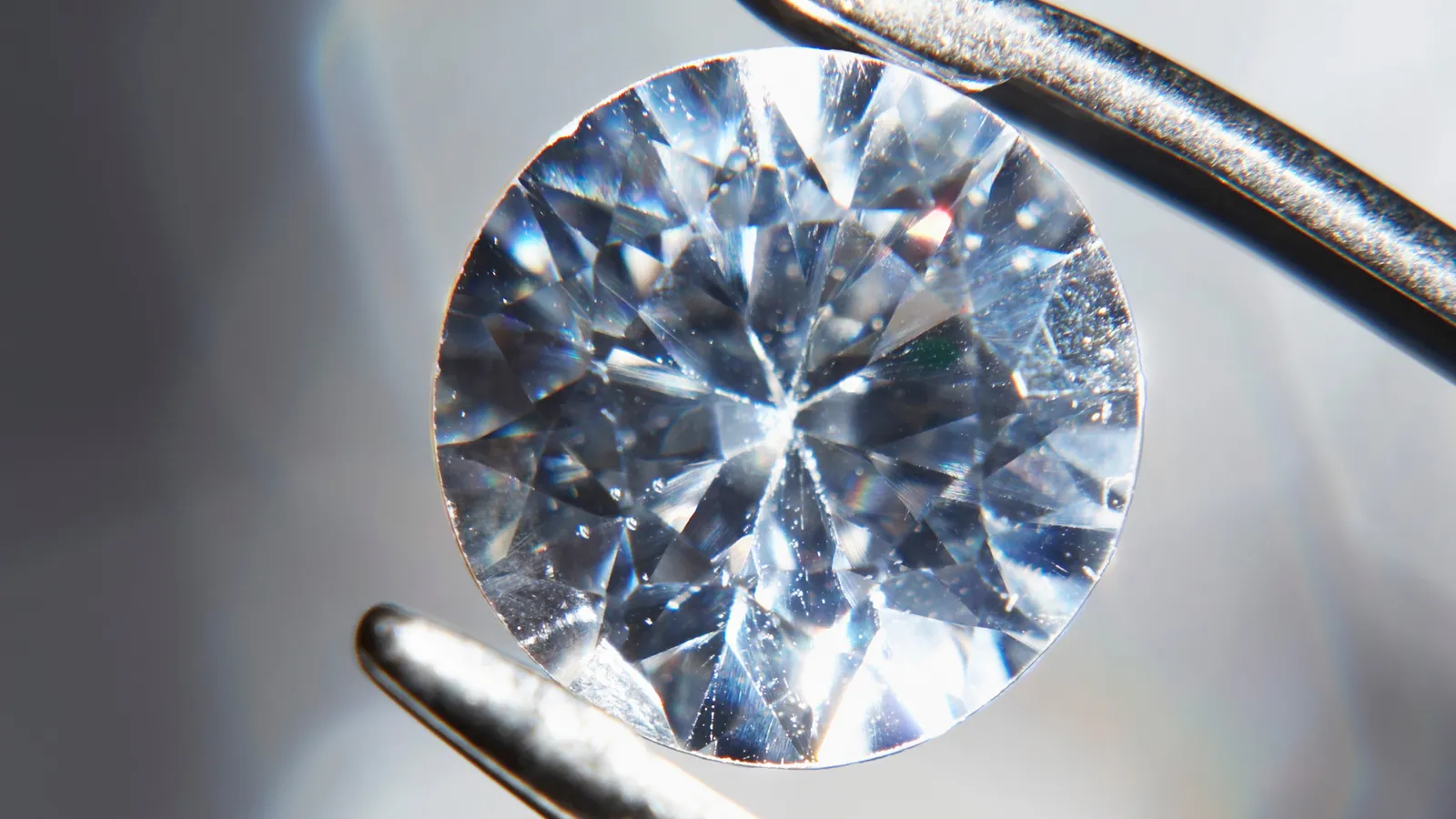
Short answer: a twinning wisp is an internal clarity characteristic: a series of pinpoints, clouds or crystals that formed along a twin plane, a place where the diamond’s crystal structure changed direction as it grew. It often looks like a faint ribbon or swirl. Small, faint wisps barely matter, and you’ll see them in high clarity grades; large or dense ones can make a stone look hazy and lower its grade.
At a glance
| Question | Answer |
|---|---|
| What is it? | Pinpoints, clouds or crystals aligned along a twin plane |
| Where does it come from? | A change in crystal orientation during growth |
| How common? | Seen in about 10% of type Ia diamonds in one GIA study |
| Affects durability? | Not normally |
| Affects appearance? | Only when large, dense or near the surface |
| Shown on reports? | Yes, on the clarity plot |
How does a twinning wisp form?
Diamonds grow as crystals deep in the earth’s mantle. Sometimes, partway through growth, the orientation of the crystal structure shifts, creating a boundary called a twin plane. GIA describes twinning wisps as atomic-level defects along this plane.
Tiny inclusions such as pinpoints (very small crystals) and clouds (clusters of pinpoints) can gather along that boundary. Because the plane often twists through the stone, the wisp can look like a ribbon, a streak or a spiral.
How common are twinning wisps?
GIA research cited in a 2023 article found twinning wisps in about 10% of type Ia diamonds. Type Ia is the most common category of natural diamond, containing nitrogen in clusters.
In the same article, GIA showed an SI1 round diamond whose wisps happened to form the outline of a whale, a reminder that inclusions can be fascinating as well as flaws.
How do twinning wisps affect clarity?
Graders look at the wisp’s:
- Size: how much of the diamond it spans.
- Density: a faint ghostly wisp vs. a dense, white band.
- Position: under the table (the top facet) is most visible.
- Relief: how much it contrasts with the surrounding diamond.
A faint wisp can appear in VVS and VS grades and be invisible without magnification. Large, dense wisps that scatter light can push a stone into SI grades and make it look slightly milky. See what is diamond clarity for how grades work.
Should you avoid a diamond with a twinning wisp?
Not automatically. Ask:
- Is it eye-clean? If you can’t see it at normal viewing distance, it doesn’t affect beauty.
- Does the stone look bright? Dense wisps can dull transparency. Compare video of the actual stone with others.
- Is it the grade-setting inclusion? Reports list inclusions in order of importance. If the wisp is the main one, look closely.
- What does the price reflect? You shouldn’t pay a premium for a stone with a dense, visible wisp.
For a broader list, see diamond inclusions to avoid and our overview of what diamond inclusions are.
How twinning wisps appear on a grading report
Major labs mark twinning wisps on the clarity plot with their own symbol and list them under clarity characteristics. If “twinning wisp” is first in the list, it’s likely the main reason for the grade. Our guide on how to read a GIA diamond certificate shows where to look.
Frequently asked questions
Are twinning wisps found in lab-grown diamonds?
They’re associated with natural diamond growth and twinning. Lab-grown diamonds have their own typical inclusions, such as metallic flux in some HPHT stones.
Is a twinning wisp the same as a cloud?
Not exactly. A cloud is a cluster of pinpoints. A twinning wisp can contain clouds, pinpoints or crystals, but they’re arranged along a twin plane, often in a twisting, ribbon-like shape.
Can a twinning wisp be removed?
No. It runs through the interior of the stone, so it can’t be polished or lasered away practically.
Will a twinning wisp make my diamond crack?
Wisps aren’t breaks, so they aren’t normally a durability concern. Feathers that reach the surface are the inclusions to worry about.