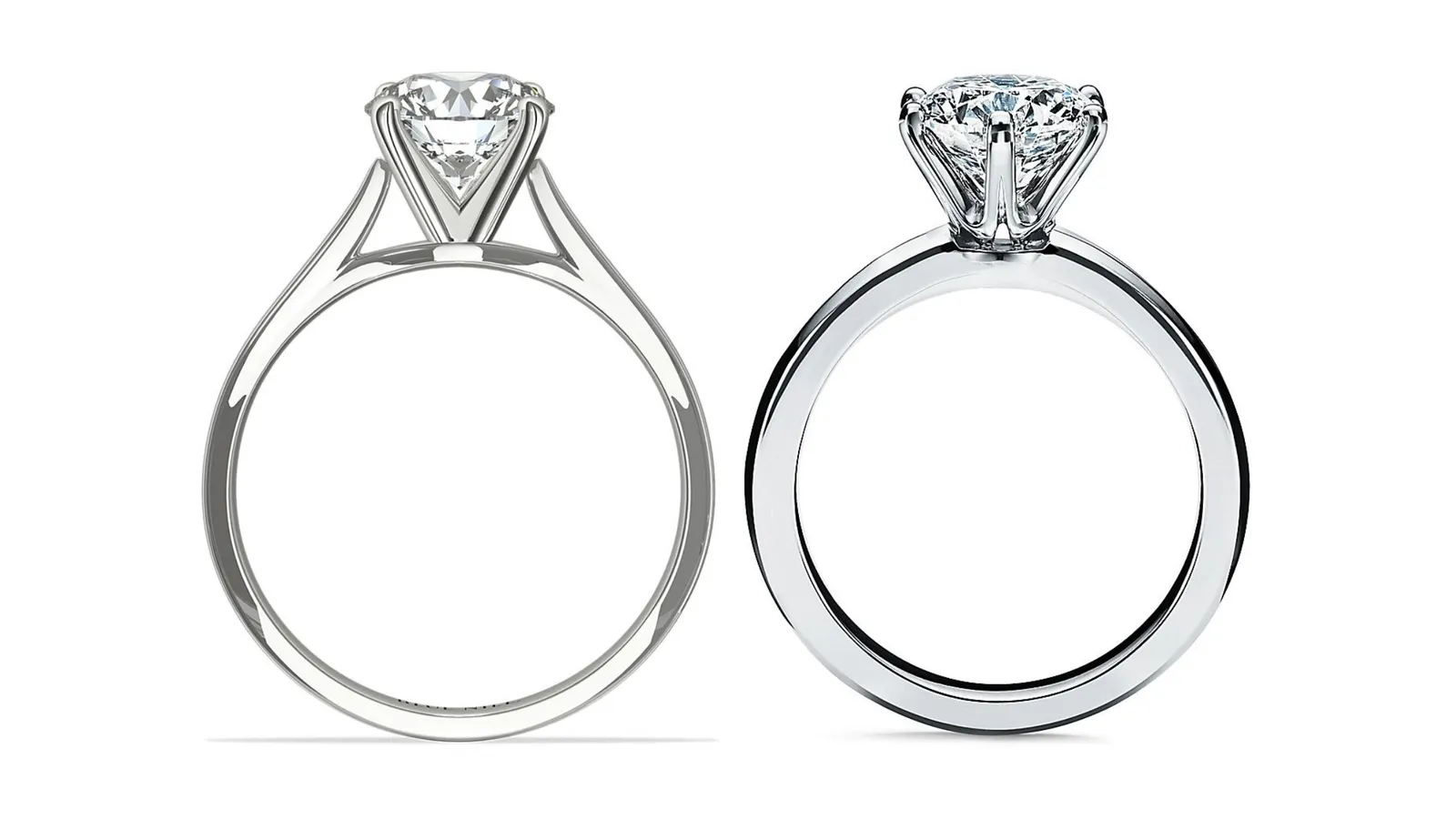
Short answer: a cathedral setting has arches of metal sweeping up from the band to hold the stone, like the arches of a cathedral. A Tiffany setting is a six-prong solitaire head that lifts a round diamond high above a plain band. They describe different parts of the ring, so you can combine them, but in their classic forms the cathedral looks more structured and elegant from the side, while the Tiffany style looks lighter and more minimal.
At a glance
| Cathedral setting | Classic Tiffany-style | |
|---|---|---|
| Defining feature | Metal arches on the shoulders | Six prongs on a raised head |
| Side profile | Sweeping, architectural | Slim prongs rising from a straight band |
| Height | Usually high | Usually high |
| Stone support | Arches plus prongs | Prongs only |
| Snag risk | Moderate | Moderate to high |
| Works with | Most shapes | Round diamonds especially |
What is a cathedral setting?
In a cathedral setting, the band rises in two arches on either side of the center stone. The head (usually prongs, sometimes a bezel) sits between them. The arches add support and give the ring a graceful side view.
Common features:
- Works with round, oval, cushion, princess, pear and other shapes
- Often combined with four or six prongs
- Can be plain metal or have pavé diamonds on the arches
- Lets a straight wedding band sit closer underneath
What is a Tiffany setting?
Tiffany & Co. introduced the Tiffany Setting in 1886, under Charles Lewis Tiffany. It uses six prongs to lift a round brilliant diamond above the band so light can reach it from all sides. Other jewelers offer similar “six-prong solitaire” or “Tiffany-style” designs.
Classic features:
- Six slim prongs, evenly spaced
- A plain, narrow band
- A high head with no arches
- Designed mainly for round stones
Cathedral vs. Tiffany: key differences
Look
The cathedral’s arches make the ring look substantial and elegant from the side. The Tiffany style is about minimalism, with almost nothing between your eye and the diamond.
Security
Cathedral arches add support where the head meets the band. Six prongs, used in both styles, provide backup if one prong is damaged.
Everyday wear
Both are fairly tall, so both can catch on clothing or hair. A cathedral’s arches can collect lotion and dirt, while the Tiffany style’s high, open head is easy to clean but more exposed.
Wedding band pairing
Cathedral settings often let a straight band sit flush. A high Tiffany-style head can also clear a straight band, but check the gap. See can you add diamonds to a wedding band if you’re planning the set.
Which should you choose?
| If you want… | Choose |
|---|---|
| A classic, minimal solitaire | Tiffany-style six-prong |
| A dramatic side profile | Cathedral |
| A shape other than round | Cathedral (or four prongs) |
| Extra structural support | Cathedral |
| Both | Six prongs on cathedral shoulders |
Related styles to compare
- Trellis setting: prongs that weave past each other. See trellis vs. cathedral settings.
- Four-prong solitaire: see Tiffany setting vs. prong setting.
- Knife-edge band: a sharp, ridged band that pairs well with both. See what a knife-edge ring is.
Frequently asked questions
Can a Tiffany-style ring also be a cathedral setting?
Yes. “Cathedral” describes the arches on the shoulders, while “six-prong” describes the head. Many solitaires combine six prongs with cathedral shoulders.
Does a cathedral setting make the diamond look bigger?
It raises the stone and draws the eye upward, which can make it look more prominent. Actual face-up size depends on the stone, not the setting.
Is a cathedral setting harder to clean?
Slightly. Dirt can collect where the arches meet the head. A soft toothbrush and warm soapy water usually handle it.
Will a straight wedding band sit flush against a cathedral ring?
Often, yes, because the arches lift the stone above the band. Fit still depends on the specific setting height, so try them together before buying.