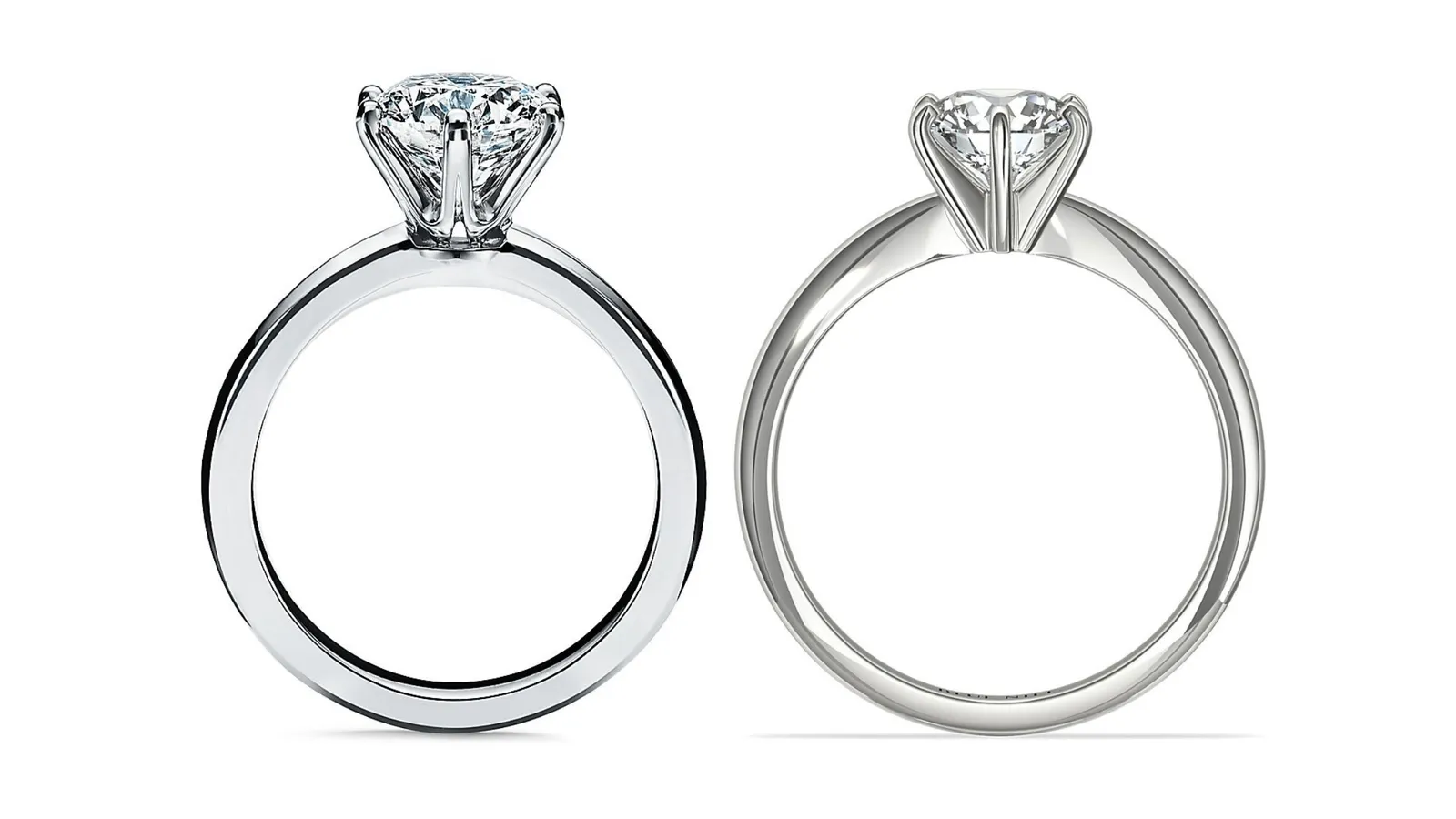
Short answer: a Tiffany setting is a prong setting. “Prong setting” is the broad category: any ring where small metal claws hold the stone. The Tiffany Setting is one famous version: six slim prongs that lift a round diamond high above a plain band. The real choice is how many prongs you want, how high the stone sits and what shape the prongs are.
At a glance
| Tiffany-style (six-prong) | Classic four-prong | |
|---|---|---|
| Prongs | 6 | 4 |
| Best for | Round diamonds | Rounds, cushions, princess, ovals |
| Stone outline | Looks rounder | Looks slightly squarer |
| Security | Higher (more backup prongs) | Good |
| Stone visibility | Slightly less | Slightly more |
| Height | Usually high | Can be high or low |
What is a prong setting?
In a prong setting, metal claws (prongs) rise from the ring’s head and bend over the edge of the stone to hold it. Because little metal surrounds the stone, light can enter from the sides as well as the top, which helps diamonds sparkle.
Prong settings vary in:
- Number of prongs: usually 4 or 6; some designs use 3 (for triangles), 5 or 8.
- Prong tips: rounded, claw (pointed), flat, V-shaped (to protect pointed corners) or double prongs.
- Height: high settings show off the stone; low ones are less likely to catch.
What is the Tiffany setting?
Tiffany & Co. introduced the Tiffany Setting in 1886, under founder Charles Lewis Tiffany. It uses six prongs to lift a round brilliant diamond above the band, letting light in and making the stone the focus. The name belongs to Tiffany; elsewhere you’ll see “Tiffany-style” or “six-prong solitaire.”
Features of the style:
- Six slim prongs, evenly spaced
- A plain, usually narrow band
- A high head that raises the stone
- Most often paired with a round diamond
Six prongs vs. four prongs
Six prongs
- Pros: extra security, a rounder look on round stones, a classic profile.
- Cons: a little more metal over the diamond; can look busy on very small stones.
Four prongs
- Pros: shows more of the stone, clean modern look, works well with square and rectangular cuts.
- Cons: if one prong fails, the stone is at greater risk.
How to choose
| If you… | Consider |
|---|---|
| Want the classic round solitaire look | Six-prong Tiffany-style |
| Have a princess or cushion cut | Four prongs, with V-tips on pointed corners |
| Work with your hands | Lower head, four or six rounded prongs, or a bezel |
| Want the stone to look as big as possible | Four slim prongs on a thin band |
| Want maximum security | Six prongs, or double prongs |
Caring for any prong setting
- Check prongs yearly for wear and bending.
- Clean under the stone, where lotion and dirt collect.
- Have worn prong tips rebuilt (retipped) before they get too thin.
Want to compare more styles? See cathedral vs. Tiffany settings, whether a solitaire is boring, and our overview of engagement ring settings.
Frequently asked questions
Can any jeweler make a Tiffany setting?
“Tiffany Setting” is Tiffany & Co.’s own name for its ring. Other jewelers sell similar six-prong solitaires, often described as “Tiffany-style” or simply as six-prong solitaires.
Is a six-prong setting more secure than four prongs?
Generally yes. If one prong bends or breaks, five others still hold the stone. The trade-off is slightly more metal covering the diamond.
Does a high prong setting snag?
Taller settings catch on sweaters, hair and gloves more than low ones. If you work with your hands, ask for a lower head or rounded prong tips.
How often should prongs be checked?
A quick check by a jeweler about once a year is a good habit, and sooner if you knock the ring hard or the stone feels loose.