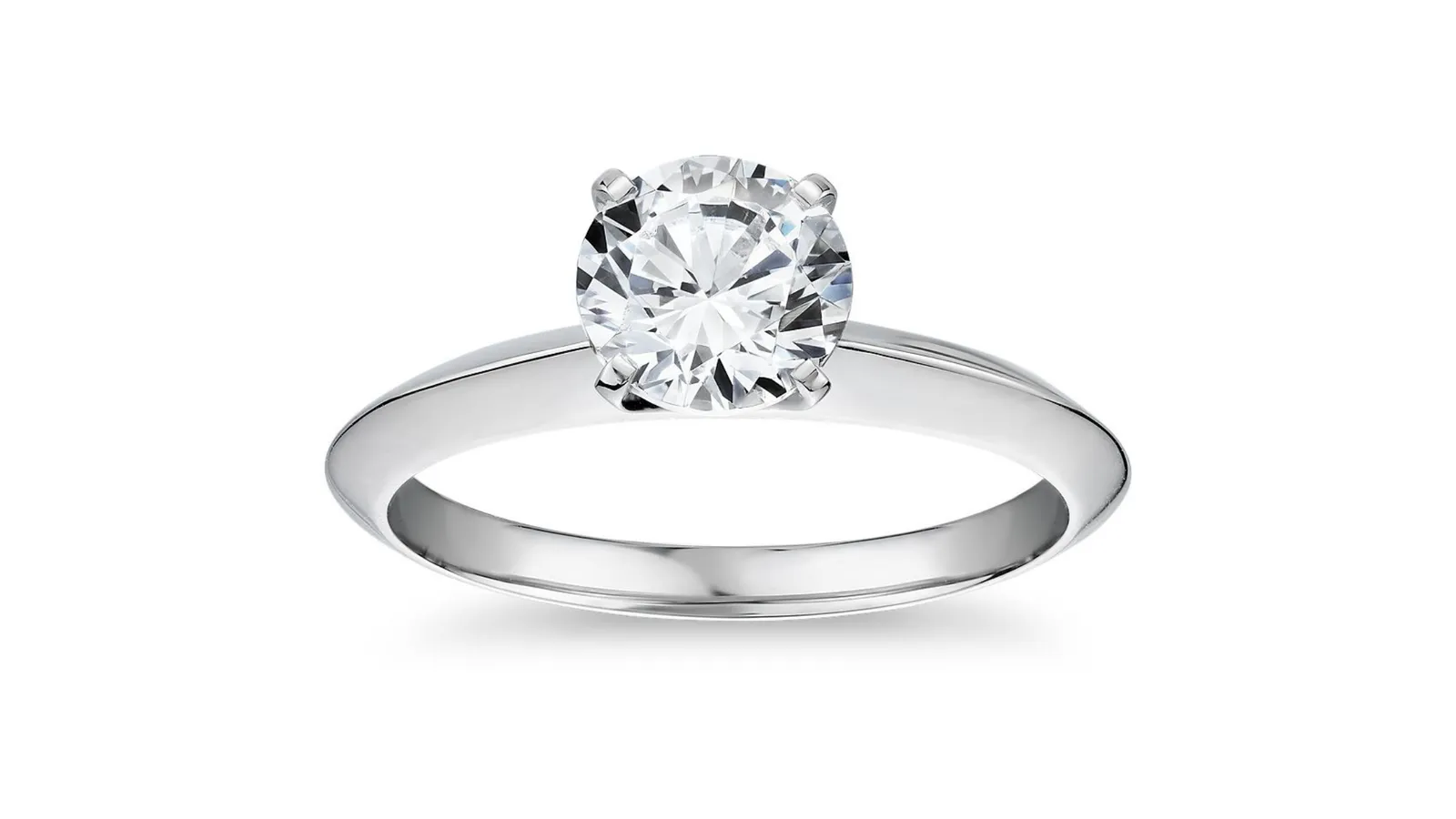
Short answer: a knife-edge ring has a band that slopes up from both sides to a fine ridge on top, like the edge of a blade, instead of being flat or rounded. Seen from above, it looks very thin, which makes a center stone appear more prominent. It’s a popular profile for solitaire engagement rings and simple bands.
At a glance
| Knife-edge band | |
|---|---|
| Profile | Two sloping sides meeting in a ridge |
| Look | Slim, crisp, light-catching line |
| Best with | Solitaires, especially round and oval stones |
| Comfort | Similar to other bands when well finished |
| Watch-outs | Ridge can soften over years; resizing needs care |
What does “knife-edge” mean?
The term describes the band’s cross-section, the shape you’d see if you sliced through it. Most bands are:
- Flat: straight top surface
- Half-round: domed on top, flat inside
- Comfort fit: rounded inside and out
- Knife-edge: two sloped faces meeting in a peak
The ridge catches light as a thin bright line, and because the top is so narrow, the band looks finer from above than it actually is.
Why people choose knife-edge rings
- The stone looks bigger. A slim band creates contrast that makes the center stone stand out.
- It’s understated. No extra stones or decoration, just a clean line.
- Light play. The two angled faces reflect light differently, giving the band a bit of sparkle of its own.
- Classic with a twist. It reads as traditional but slightly more modern than a flat band.
Downsides to consider
- Ridge wear. Over many years of daily wear, the peak can soften. A jeweler can often refresh the shape when polishing.
- Stacking. The peaked top can leave small gaps next to flat wedding bands.
- Resizing. The ridge has to be rebuilt evenly at the joint, so it’s a slightly more skilled job.
- Thin versions bend more easily. Choose a band with enough depth (height from finger to top), especially in softer metals like high-karat gold.
Knife-edge vs. other popular band styles
| Band | Look | Best for |
|---|---|---|
| Knife-edge | Slim, crisp ridge | Making a solitaire pop |
| Flat | Modern, bold | Engraving and stacking |
| Half-round | Classic, soft | Everyday comfort |
| Beveled | Angled edges, flat top | A tailored, structured look |
| Pavé | Small diamonds set along the band | Extra sparkle |
Pairing a knife-edge band with a setting
A knife-edge band pairs naturally with:
- Four-prong or six-prong solitaires. See Tiffany setting vs. prong setting.
- Cathedral shoulders, where the ridge flows into the arches.
- Bezel settings for a modern, streamlined look.
If you’re worried a plain ring might feel too simple, read is a solitaire engagement ring boring.
Is a knife-edge ring right for you?
It suits you if you want a delicate look, a center stone that stands out, and a band without extra stones to maintain. If you prefer a sturdier feel or plan to stack lots of bands, a half-round or comfort-fit band may be easier to live with.
For the anatomy of a ring, see what a ring shank is.
Frequently asked questions
Is a knife-edge band sharp?
No. The “edge” is a ridge you can see, not a blade you can feel. A well-made band is smoothly polished and comfortable to wear.
Is a knife-edge band weaker than a regular band?
Not necessarily. The peaked shape puts metal on top of the band where it can look slim from above while keeping depth. Very thin bands of any profile are more prone to bending.
Can a knife-edge ring be resized?
Usually, yes. A jeweler has to rebuild the ridge neatly at the joint, so choose someone experienced, and expect pavé versions to be trickier.
Does a knife-edge engagement ring go with a flat wedding band?
It can, but the shapes contrast. Many people pair it with a matching knife-edge or a thin round band for a seamless stack.