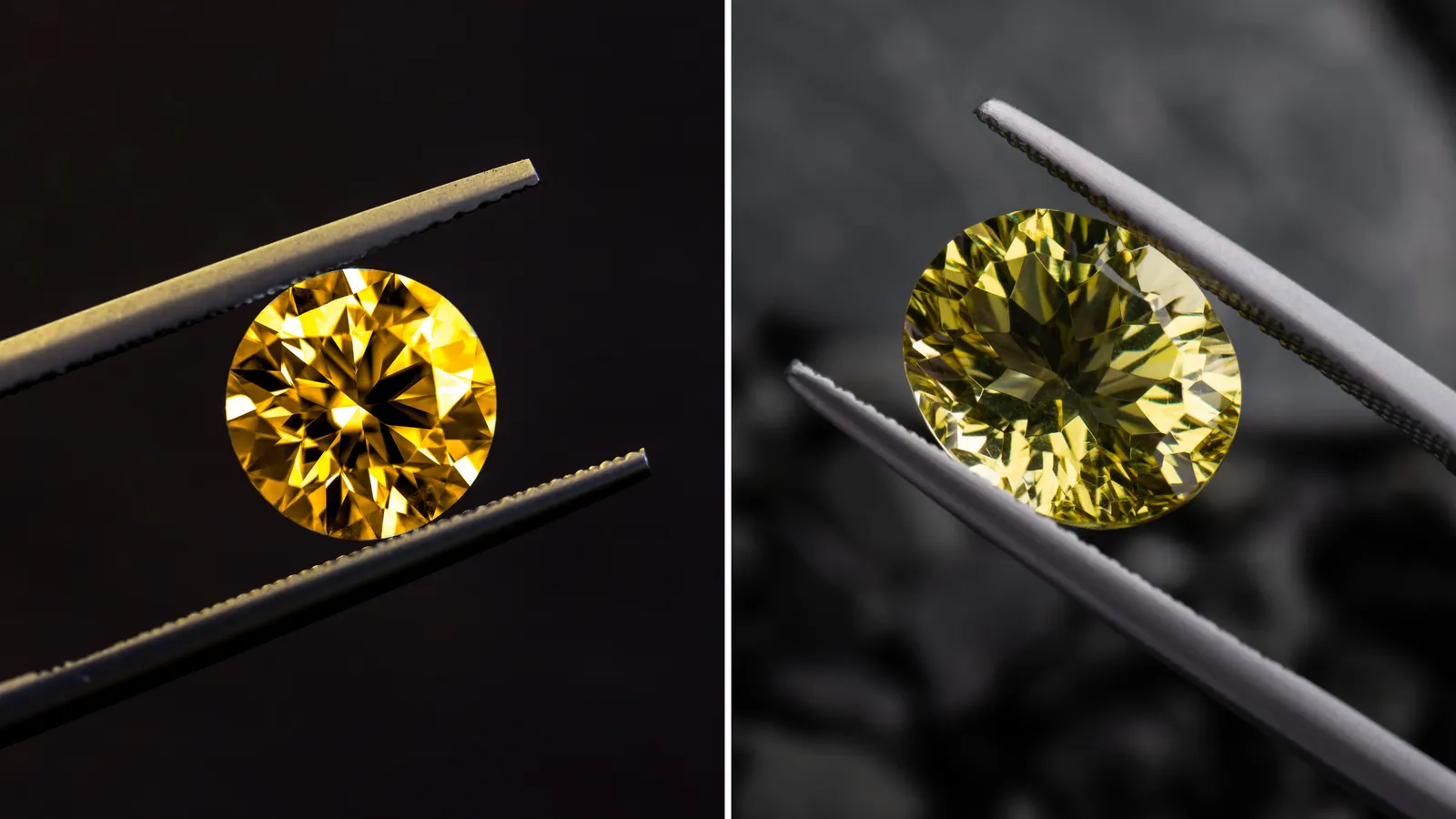
Short answer: a yellow diamond usually shows brighter sparkle and more flashes of rainbow “fire” than a yellow sapphire, and for the same carat weight it looks a little larger. A sapphire tends to look more glassy and evenly colored. Those clues help, but the only reliable way to tell them apart is a gemologist’s test or a lab report.
At a glance
| Property | Yellow diamond | Yellow sapphire |
|---|---|---|
| Mineral | Carbon | Corundum (aluminum oxide) |
| Hardness (Mohs) | 10 | 9 |
| Refractive index | 2.42 | 1.762–1.770 |
| Specific gravity | 3.52 | 4.00 |
| Refraction | Single | Double |
| Look | Intense sparkle, strong fire | Glassy brilliance, little fire |
| Size for 1 ct | Larger face-up | Slightly smaller face-up |
Values from GIA’s Gem Encyclopedia.
Why they’re easy to confuse
Both stones come in similar shades, from pale lemon to rich golden yellow, and both are often cut as rounds, ovals and cushions. Set in yellow gold, a well-cut yellow sapphire can pass for a diamond at a glance, especially in small sizes.
5 visual clues to look for
1. Sparkle and fire
Refractive index measures how strongly a gem bends light. Diamond’s is about 2.42, while sapphire’s is about 1.76–1.77. That difference gives diamond much brighter, crisper sparkle and more colorful flashes when you move it under a spotlight or sunlight. Sapphire looks bright but more glassy, with less rainbow fire.
2. Facet doubling
Sapphire is doubly refractive, meaning light splits into two rays inside it. Under a loupe, you may see back facet edges look slightly doubled. In sapphire the effect is subtle and easier to spot in larger stones. Diamond is singly refractive, so its facet edges look sharp and single.
3. Size for the weight
Sapphire is denser (specific gravity about 4.00 vs diamond’s 3.52). A 1-carat yellow sapphire is physically smaller than a 1-carat yellow diamond of the same shape. If a stone looks small for its stated weight, it may be sapphire.
4. Color character
There’s lots of overlap, but yellow sapphires often show slightly different shades when viewed from different angles, an effect called pleochroism. Many yellow sapphires are also heat-treated to improve their color. Yellow diamonds often look very even, and intense “canary” colors command a premium.
5. Wear on the facet edges
Diamond is the hardest natural material, so its facet edges stay crisp for decades. An older sapphire may show tiny nicks or rounded edges where it has been knocked. That only helps with worn stones, though.
Don’t do a scratch test
Scratching your stone against glass or another gem doesn’t separate diamond from sapphire (both easily scratch glass) and can chip or damage either one.
How to confirm it
- Look for a lab report. A GIA or other reputable lab report states the species and whether the color is natural or treated.
- Ask a gemologist. With a refractometer, a polariscope and magnification, a gemologist can separate the two quickly. GIA notes that many yellow gems look alike and that some need advanced testing to identify.
- Use a diamond tester as a first step. It can help, but results depend on the type of tester. Learn more about how diamond testers work.
Price differences
For similar size and color strength, a yellow diamond generally costs more than a yellow sapphire. Price depends heavily on how strong the color is, the stone’s size, its cut and whether it’s treated. Because of that, price can hint at what a stone is, but it’s never proof.
Which should you choose?
- Choose a yellow diamond if you want maximum sparkle and hardness and your budget allows. See candy-colored diamonds for more fancy color options.
- Choose a yellow sapphire if you want a durable, colorful stone at a lower price. Sri Lanka is a well-known source; read about Ceylon sapphires and Montana sapphires.
Want to check whether a white stone is a real diamond? Here’s how to tell if your diamond is real.
Frequently asked questions
Are yellow diamonds more expensive than yellow sapphires?
Generally, yes, for stones of similar size and color strength. Prices vary a lot with saturation, size and treatment, so compare like with like.
Will a diamond tester tell a yellow diamond from a yellow sapphire?
A tester can be a helpful first check, but results depend on the type of tester and how it’s used. For a valuable stone, a gemologist or lab report is the reliable answer.
Why does my 1-carat yellow sapphire look smaller than a 1-carat diamond?
Sapphire is denser than diamond (specific gravity about 4.00 vs 3.52), so the same weight takes up less space. A 1-carat sapphire usually looks a bit smaller face-up.
Can a yellow sapphire be worn every day?
Yes. At 9 on the Mohs scale, sapphire is very durable and a great choice for an everyday ring. Diamond, at 10, is harder still.