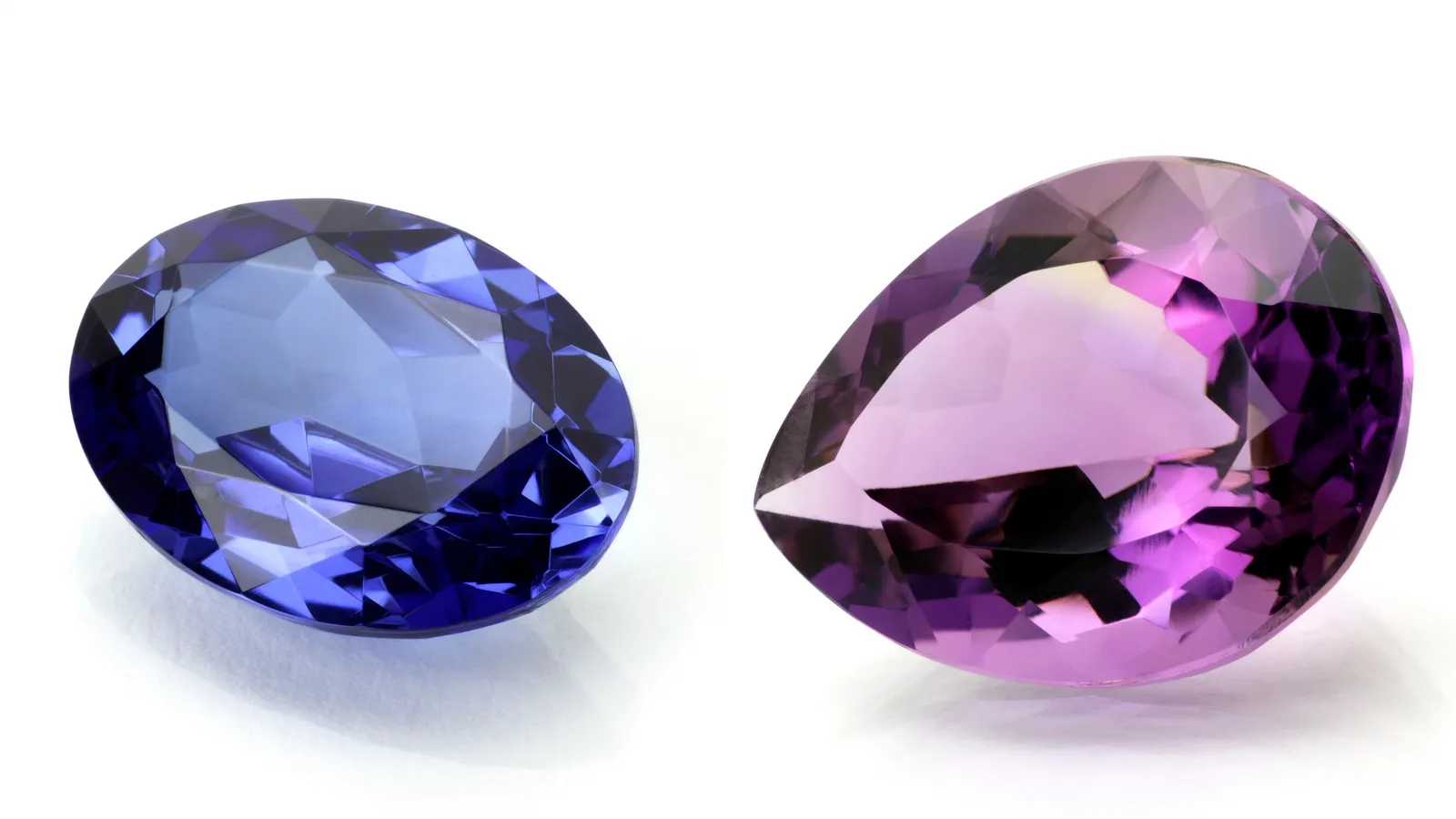
Short answer: amethyst is purple quartz; tanzanite is a blue-violet variety of the mineral zoisite. Amethyst is harder (7 on the Mohs scale vs. 6 to 7), mined in many countries and affordable even in large sizes. Tanzanite comes from a single small area of Tanzania, shows blue and violet depending on the angle, and usually costs more.
At a glance
| Tanzanite | Amethyst | |
|---|---|---|
| Mineral | Zoisite | Quartz |
| Color | Blue to violet, often both | Lilac to deep reddish purple |
| Mohs hardness | 6 to 7 | 7 |
| Toughness | Fair to poor | Good for daily wear |
| Source | Merelani Hills, Tanzania only | Brazil, Uruguay, Bolivia and many others |
| Discovered | 1967 | Used for thousands of years |
| Birthstone | December | February |
| Typical price | Higher | Lower, even for large stones |
Color: the easiest way to tell them apart
Tanzanite
Tanzanite is pleochroic: it shows different colors when you look at it from different directions. GIA describes seeing three distinct colors in three crystal directions. In jewelry, that usually means a stone that looks bluer from one angle and more violet from another. Most tanzanite is heat-treated to produce its blue-violet color, a stable and standard treatment.
Amethyst
Amethyst’s color stays the same purple from any angle. GIA describes the ideal as strong reddish purple to purple. Lighter lavender shades are common and popular too.
Quick test: tilt the stone under a bright white light. A clear shift between blue and purple points to tanzanite.
Hardness and durability
| Tanzanite | Amethyst | |
|---|---|---|
| Scratch resistance | Moderate | Good |
| Chip resistance | Fair to poor | Good |
| Daily-wear ring? | Possible, with a protective setting | Yes |
GIA says tanzanite’s fair-to-poor toughness makes it less than ideal for a ring worn every day, especially by active people. Amethyst, at 7 on the Mohs scale, is suitable for daily jewelry, though it can show wear over the years and may need repolishing.
Where they come from
- Tanzanite: first found in 1967, and GIA says its only source is the hills of Merelani in northern Tanzania. Tiffany & Co. named it after the country.
- Amethyst: mined widely. GIA mentions major deposits in Brazil, plus Bolivia, Uruguay, Morocco and Canada among other sources.
That single source is a big part of why tanzanite is considered rarer.
Price
Prices vary with size, color and clarity, but in general:
- Amethyst is one of the most affordable colored gems. GIA notes that even fine amethyst has a modest price, and that price per carat doesn’t climb steeply as stones get bigger.
- Tanzanite typically costs considerably more per carat than amethyst of similar quality, with the richest blue-violet stones at the top of the range.
Care and cleaning
| Tanzanite | Amethyst | |
|---|---|---|
| Warm soapy water | Yes | Yes |
| Ultrasonic cleaner | Not recommended | Usually OK for untreated stones |
| Steam cleaner | No | No |
| Heat and sudden temperature changes | Avoid | Avoid |
| Strong sunlight for long periods | Fine | Some amethyst can fade |
Both stones are safest cleaned with warm water, mild soap and a soft brush. For more on amethyst, see can amethyst go in water? and how to tell if amethyst is real.
Which should you choose?
- Pick amethyst if you want a durable, budget-friendly purple stone for everyday rings, or a large statement stone.
- Pick tanzanite if you love blue-violet color play and want something rarer, and you’re happy to give it a protective setting and a little extra care.
Want more options in this color family? Browse our guide to purple gemstones.
Frequently asked questions
Which is rarer, tanzanite or amethyst?
Tanzanite. GIA notes it has only one known source, the Merelani Hills in northern Tanzania, while amethyst is mined in many countries.
Is tanzanite good for an engagement ring?
It can be, with care. Tanzanite is softer and less tough than sapphire or diamond, so a protective setting and taking it off for hands-on activities help it last.
Can amethyst look blue like tanzanite?
Not really. Amethyst ranges from pale lilac to deep reddish purple. Tanzanite shows blue and violet, and often both, depending on how you tilt it.
What birthstones are tanzanite and amethyst?
Amethyst is the birthstone for February. Tanzanite is one of the birthstones for December, alongside zircon, turquoise and blue topaz.